- Restaurant Duchardt — Vienna’s understated French fine-dining restaurant in Inner Stadt, with a 6-course Chef’s Menu (omakase) and proper Austrian-French wine pairing.
- Paté en Croûte · Salmon trout with mayonnaise and turnips · Monkfish picatta finished in Japanese dashi · Black Angus filet with mushroom, leek, bacon · Gâteau Basque with apricots · closing pastries.
- QlockTwo word-clock interior · Crémant de Loire / Grüner Veltliner / Blaufränkisch wine pairings · the Vienna anniversary-dinner reservation. Visited 2026.
Visited: 2026 · Where: Restaurant Duchardt, Inner Stadt (1010 Wien), Austria — 5 min walk from Schwedenplatz U1/U4 · What I ordered: 6-course Chef’s Menu (Paté en Croûte → Salmon trout → Monkfish picatta with dashi → Filet of Black Angus → Gâteau Basque → Closing pastries) + Austrian-French wine pairing (Loire Crémant, Grüner Veltliner, Blaufränkisch) · ~€150-€220 ($165-$240) per person all-in · How I paid: Out of pocket (내돈내산 / not sponsored, no PR invite)
I visited Restaurant Duchardt for an anniversary-tier dinner reservation, and I ordered the full 6-course Chef’s Menu with the Austrian-French wine pairing. I tried the Paté en Croûte first — French classical signal — and noticed how the kitchen lets the dishes speak rather than over-decorating. My visit confirmed why this is the Vienna anniversary-dinner pick — the room reads time in German script, the format strips away choice, the 6 courses tell a complete arc.
My favorite course was the Monkfish Picatta with dashi — the technical course where the French-Italian fish technique meets Japanese kombu-bonito broth. I found this the clearest signal of Duchardt’s modern approach. I was struck by how the Austrian wines pair so well with the French food that you stop noticing them and start trusting them. I have been recommending this place to Korean travelers heading to Vienna for milestone meals.
In a quiet Inner Stadt side-street, a few minutes’ walk from Schwedenplatz, there’s a 30-seat French restaurant called Restaurant Duchardt that has become one of Vienna’s most respected fine-dining bookings. The format is a 6-course Chef’s Menu (omakase) with Austrian-French wine pairing, served on grey stoneware in a salmon-orange room presided over by a designer word-clock that reads time in German script. On a Vienna evening in 2026, this was the meal that made the trip.
| 📍 Where | Inner Stadt (1010 Wien), Austria — quiet medieval side-street, ~5 min walk from Schwedenplatz |
| 🚇 Metro | Schwedenplatz (U1 / U4), 5 min walk · or Stephansplatz (U1 / U3), 7 min |
| 🕒 Hours | Dinner only · typically 18:00–23:00 · check website / Google for opening days · closed Sundays and major holidays |
| 💰 Price | Chef’s Menu (6 courses) ~€95-€120 ($105-$132 USD) per person · wine pairing add ~€55-€75 ($60-$83) · expect €150-€220 ($165-$240) per person all-in |
| 📖 English service | Yes — bilingual menu, sommelier speaks English, multilingual front-of-house |
| 💳 Cards | All major cards · Visa / Mastercard / AMEX / contactless |
| 💶 Tip | 10% standard in Vienna · 12-15% for exceptional service at fine-dining level |
| 📞 Reservation | Essential — book 5-7 days ahead for weekends, 2-3 days for weekday dinner · phone or online · only ~30 covers total |
| 👔 Dress | Smart casual · jacket appreciated for dinner · no shorts or athletic wear |
Cultural anchor for travelers: Vienna fine-dining sits at a unique geographic crossroads — Habsburg-imperial tradition + French haute-cuisine technique + Austrian wine culture + a growing willingness to incorporate Asian (especially Japanese) ingredients and methods. Restaurants like Duchardt operate at the high end of this fusion, where a classically French menu can include Japanese dashi as a finishing sauce and nobody at the table is surprised. For Korean travelers, this is the Vienna restaurant that pairs naturally with palate trained on similar fusion in Seoul.
The Spot — Inner Stadt, Discreet by Design
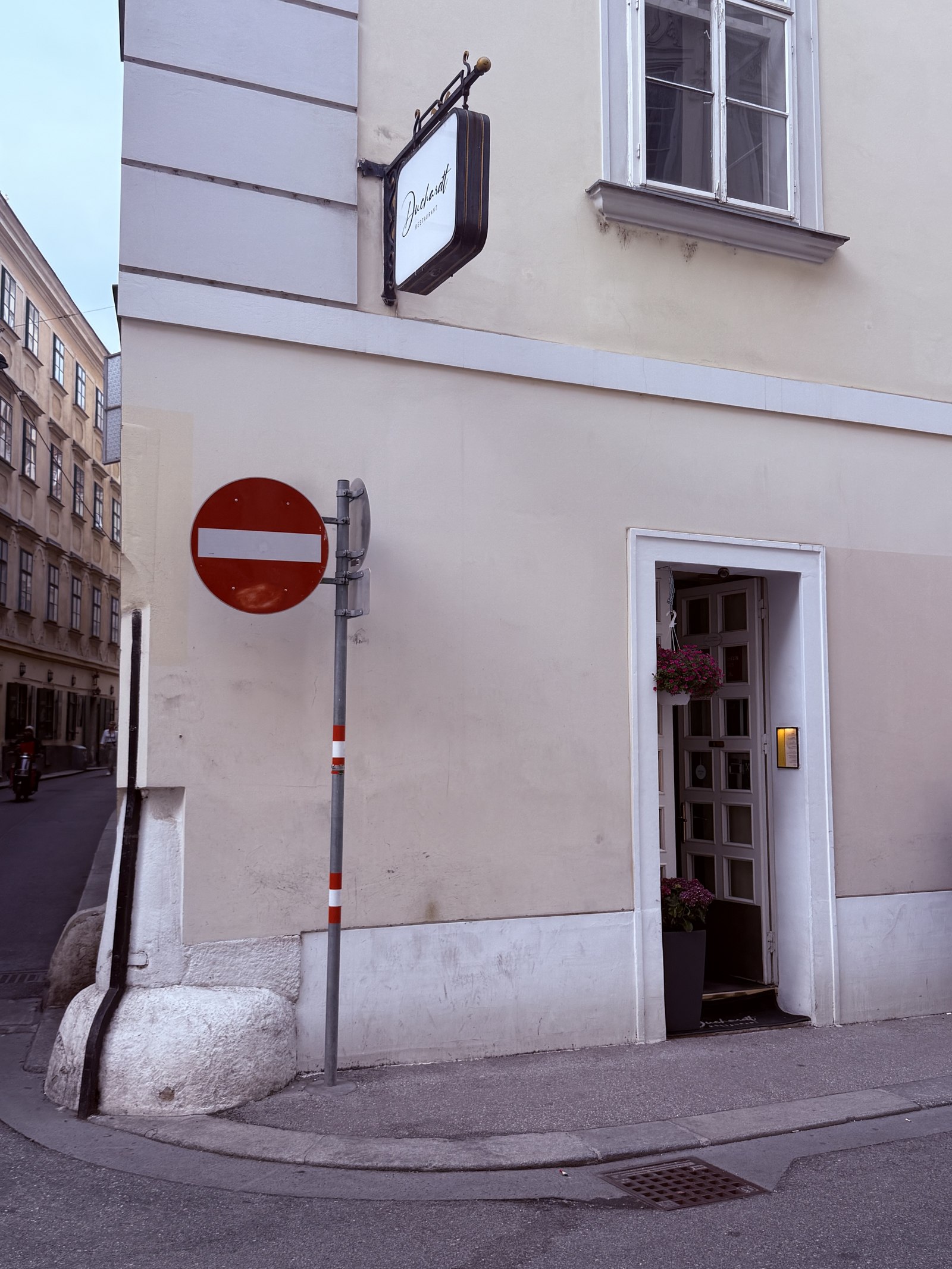
Duchardt occupies a single-story building on the corner of a narrow medieval Vienna street. The signage is intentionally understated — a small dark blade-sign with calligraphy “Duchardt” hanging above the side entrance, nothing more. If you weren’t looking for it, you would walk past it. The discretion is the signal — this is not a restaurant trying to capture foot traffic; it’s a restaurant with a 5-7-day reservation list.
The dining room is the surprise. Salmon-orange walls, dark wood, white linens, ~30 covers spread across two intimate sections. The room is built for slow eating — generous spacing between tables, low conversation levels, a sommelier moving quietly through the floor.
The QlockTwo — The Design Statement on the Wall
The single most photographed detail in the dining room is mounted on the salmon-orange wall by the bar: a QlockTwo word clock by the German designer brand Biegert & Funk. It’s a square electronic display that doesn’t show numbers at all — instead, it tells time by lighting up words in a German-language grid. When we sat down, it read: “ES IST FÜNF NACH HALB ACHT” — “It is five (minutes) past half (seven), eight” — German for 7:35 PM.
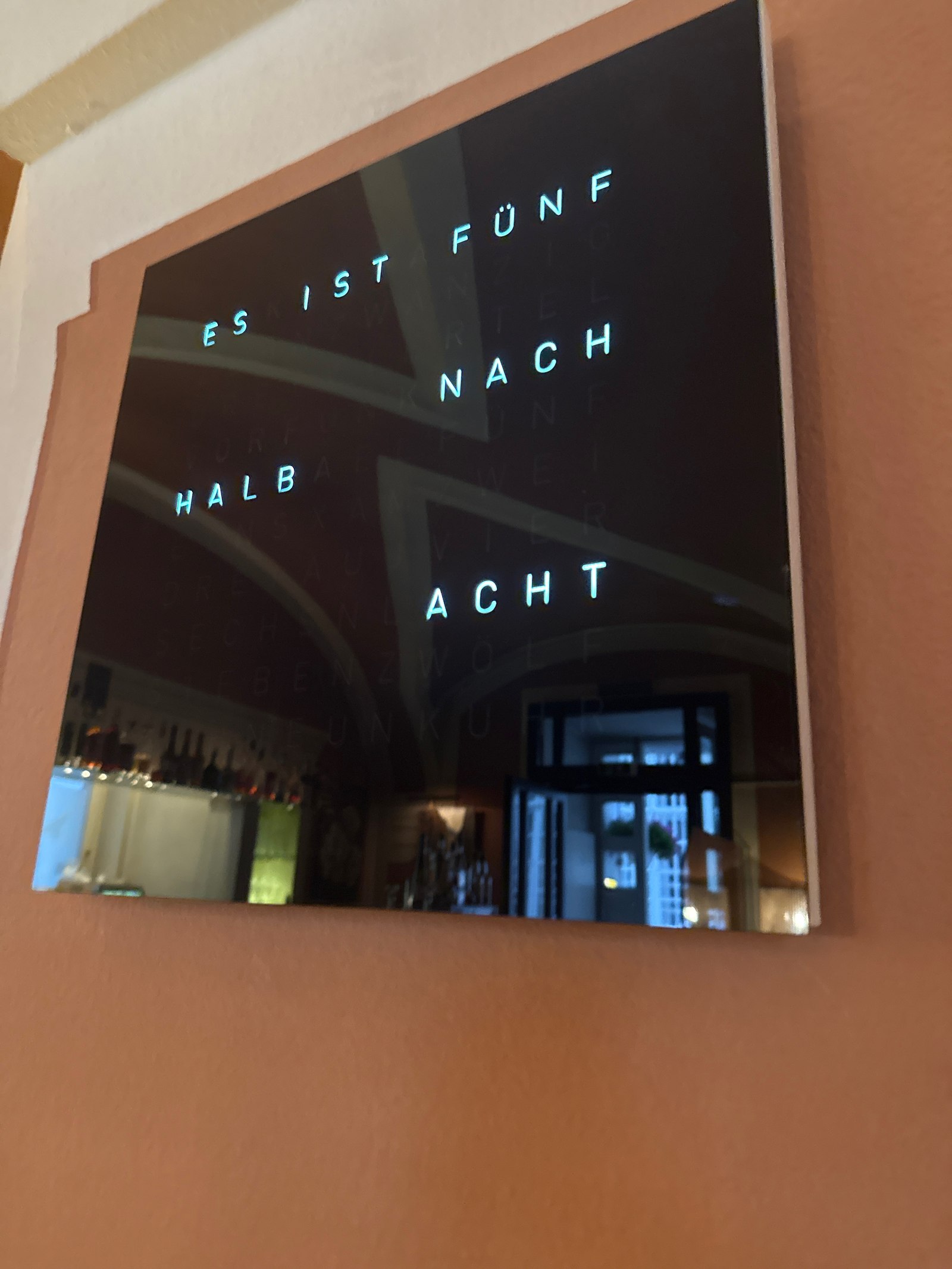
It’s a €1,500+ designer piece from one of the most respected German design brands, and it’s the kind of detail that signals what kind of restaurant you’re in. The dark glass face reflects the bar and arched ceiling behind, doubling as a kind of mirror. Mid-meal, you look up to check the time and read it as a German sentence.
The Chef’s Menu — The Format
There is no à la carte menu. Duchardt does one thing — the Chef’s Menu (Chefs Menu), a 6-course tasting menu printed on a single card with the wine pairing listed alongside. You don’t choose what to eat; you choose whether to add the wine pairing (always say yes).
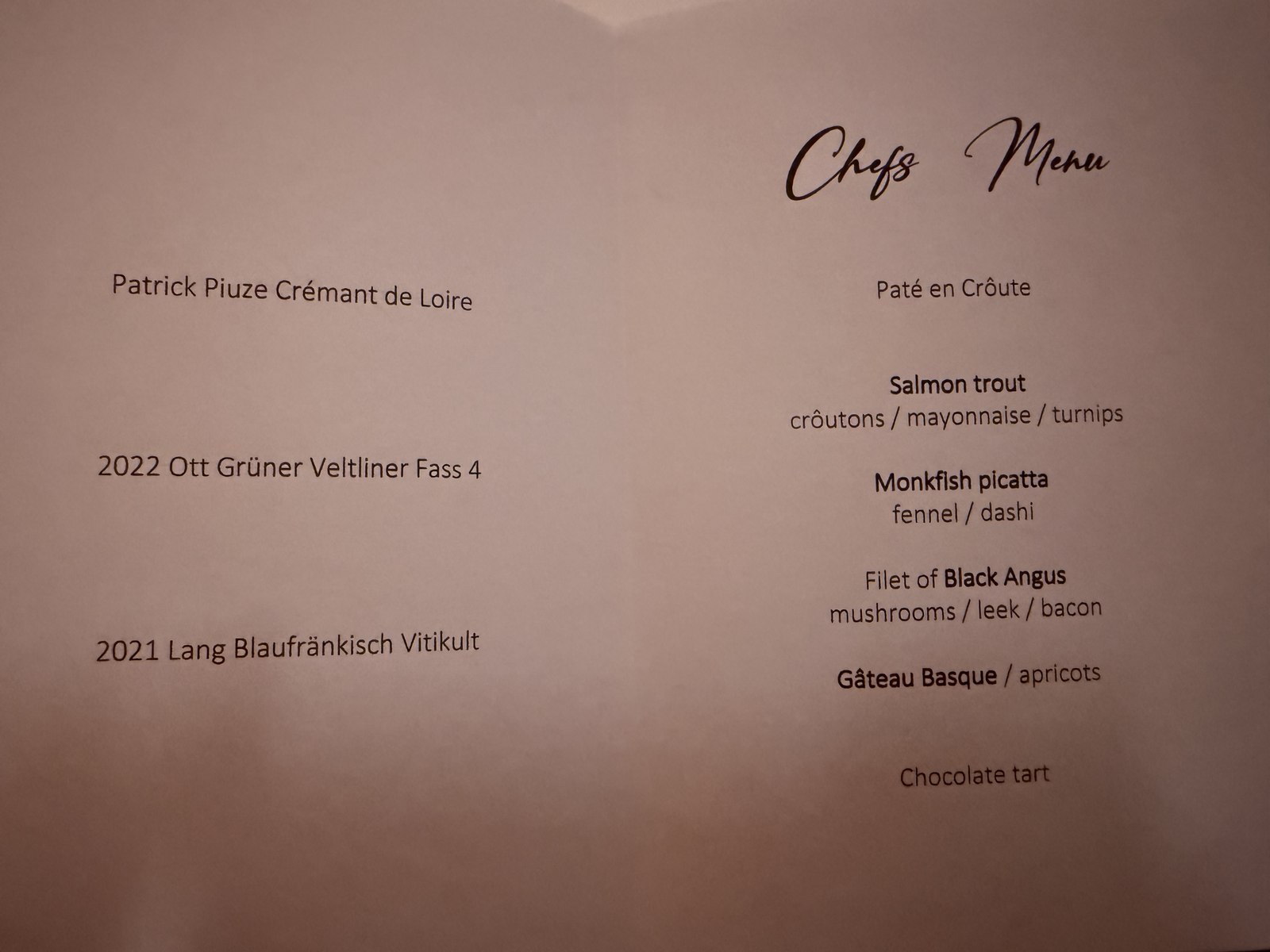
📋 Chef’s Menu — 6 Courses with Austrian-French Wine Pairing
| Course | Description | Paired Wine |
| 1. Paté en Croûte | French pastry-crust terrine — pork, chicken liver, pistachio, served with pickled shallot and grain mustard | Patrick Piuze Crémant de Loire (Loire Valley sparkling) |
| 2. Salmon Trout | Lightly-cured fish with sourdough croutons, herb mayonnaise, julienned watermelon radish, pickled turnips | 2022 Ott Grüner Veltliner Fass 4 (Austrian dry white) |
| 3. Monkfish Picatta | Egg-battered monkfish in Italian piccata style, finished in Japanese dashi broth with fennel | Continuing Grüner Veltliner |
| 4. Filet of Black Angus | Rare-cooked Black Angus tenderloin on mushroom ragout with crispy bacon and grilled baby leek | 2021 Lang Blaufränkisch Vitikult (Austrian red) |
| 5. Gâteau Basque | Traditional French Basque tart with golden almond crust, served with poached apricot compote | Dessert wine or coffee |
| 6. Chocolate Tart + Mignardises | Closing chocolate tart and small canelé-style pastries | Espresso |
Chef’s Menu price ~€95-€120 per person. Wine pairing ~€55-€75 add-on. Full experience including service charge runs €150-€220 ($165-$240 USD) per person.
The wine pairing is the move. The sommelier brings three core wines — a Loire Valley Crémant for the first course (light, sparkling, palate-opening), an Austrian Grüner Veltliner (the country’s signature white grape, perfect with fish), and an Austrian Blaufränkisch (Austrian red with the structure to handle beef). Each is poured at the right course and described in 30 seconds.
Bread + Butter Service
Before the first course, the standard French ritual: a warm bread basket and whipped house butter. Duchardt’s bread is a dark sourdough-rye loaf, sliced thick, served in a black ceramic tray with an olive-oil dropper. The butter is whipped to peaks in a small white ramekin, lightly salted, served at temperature.
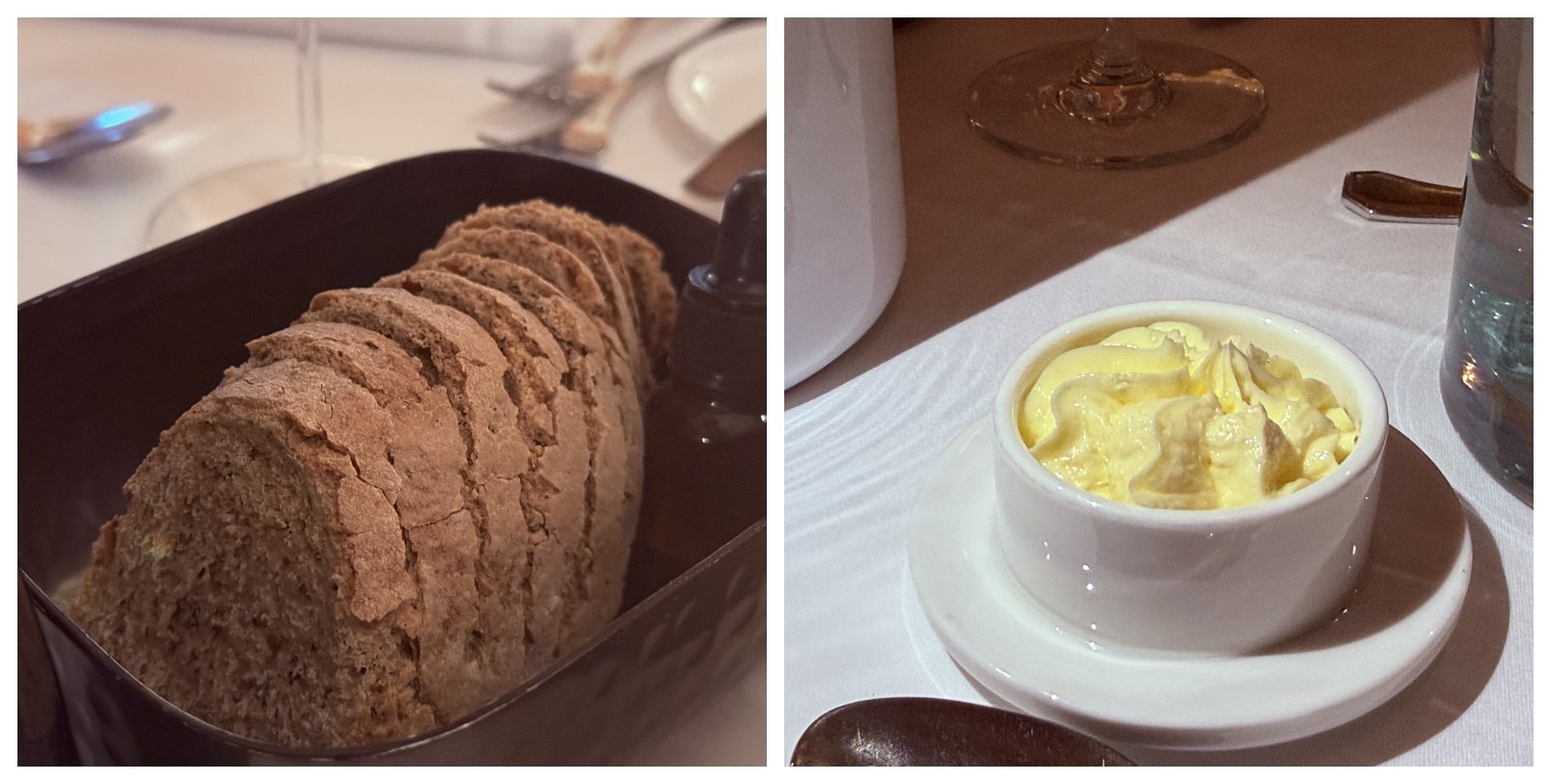
Eat the bread slowly, with multiple swipes of butter, while the wine is poured. This sets the meal’s tempo.
Course 1 — Paté en Croûte
The first course is the French classic that signals where the menu is headed: paté en croûte, a rectangular slice of terrine encased in golden pastry crust. Inside the slice, you can see cubes of pork, chicken liver, pistachio (the small green dots), and visible fat marbling. It’s served on a dark grey stoneware plate with a small pickled shallot and a quenelle of grain mustard.
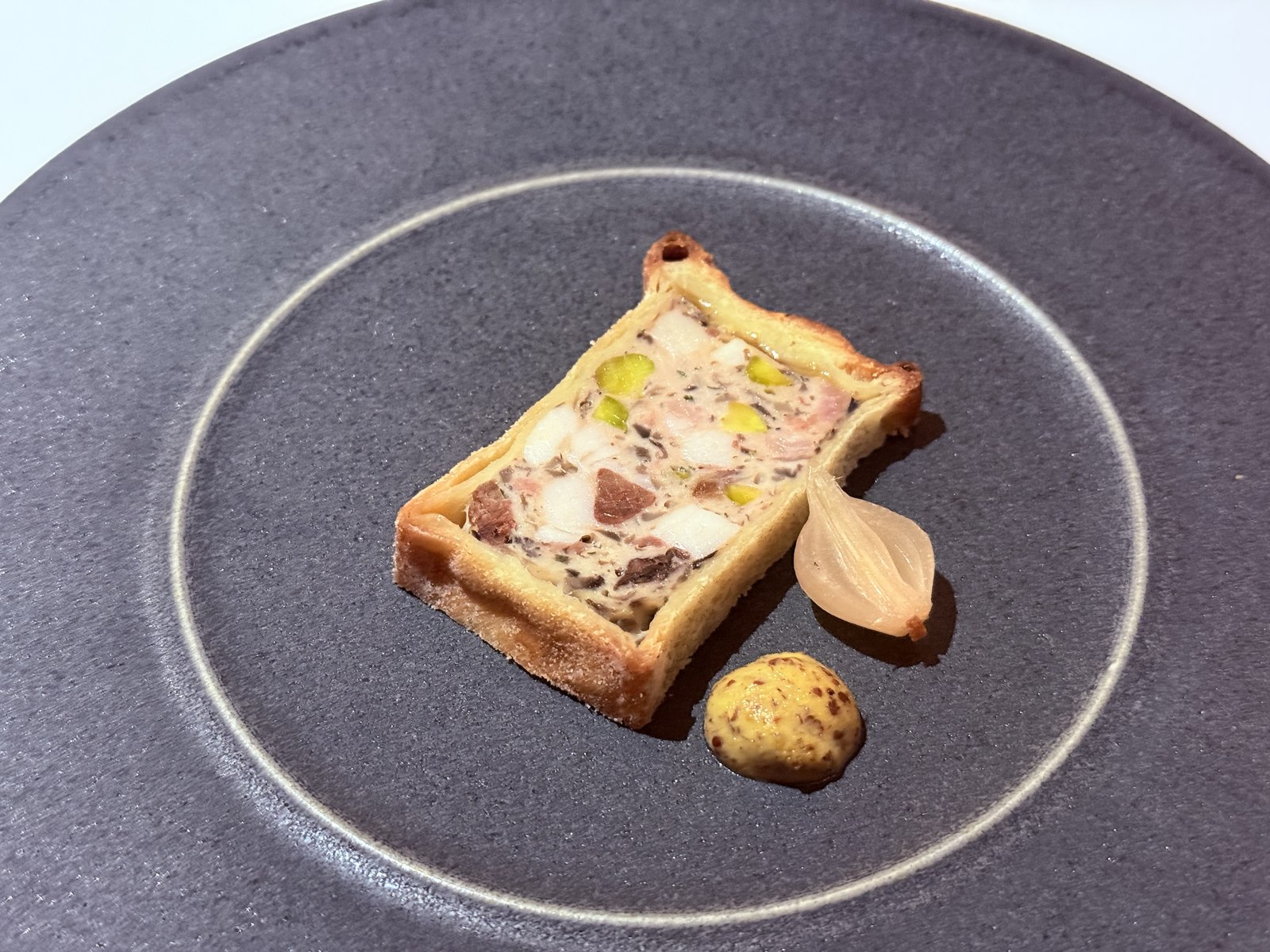
The eating order: break a small piece of pastry crust + a bite of terrine + a smear of mustard + a sliver of pickled shallot. The combination is rich, salty, slightly sweet from the pickle, sharp from the mustard. Pair with the Crémant — the sparkling bubbles cut the richness.
Course 2 — Salmon Trout
The fish course comes lighter and brighter. Lightly-cured salmon trout — somewhere between sashimi and gravlax — fanned across a wide white plate with sourdough croutons, small dots of herb mayonnaise, julienned watermelon radish (the pink-red strands), and pickled turnip slivers. The presentation is intentionally light and abstract — a watercolor composition rather than a portrait.
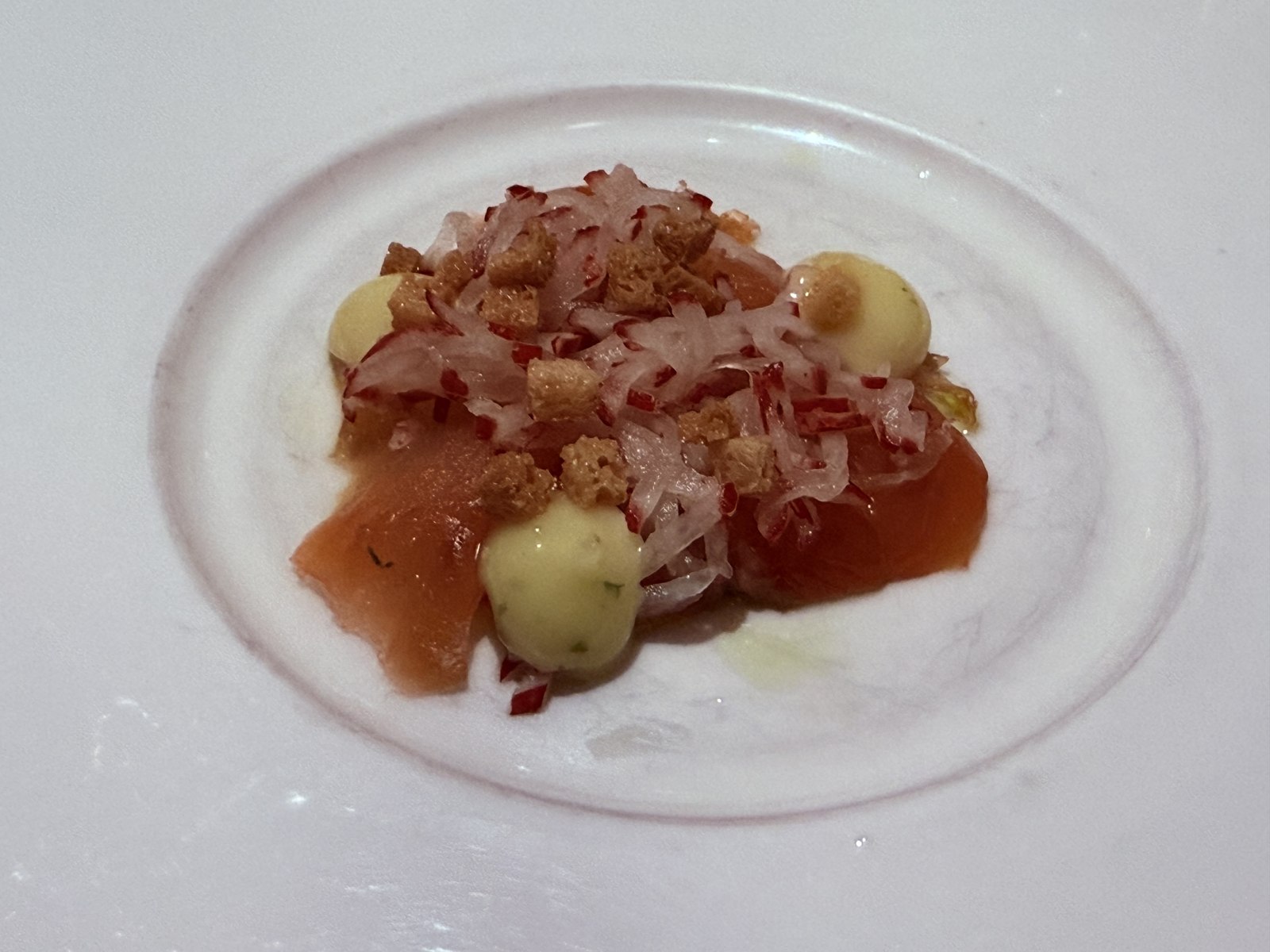
The texture interplay is the focus: soft fish, crisp croutons, crunchy radish, creamy mayo. Bright lemon-vinegar notes from the pickle. The Grüner Veltliner cuts in with its peppery white-wine acidity and ties everything together.
Course 3 — Monkfish Picatta (with Dashi)
The technical course — and the one that signals Duchardt’s modern approach. Monkfish picatta takes Italian piccata technique (egg-battered, pan-fried) and applies it to a thick chunk of monkfish, plating it in a foamy Japanese dashi broth with fennel. The dashi is the surprise — Japanese kombu-and-bonito broth as a finishing sauce on a French-Italian-trained European fish dish.
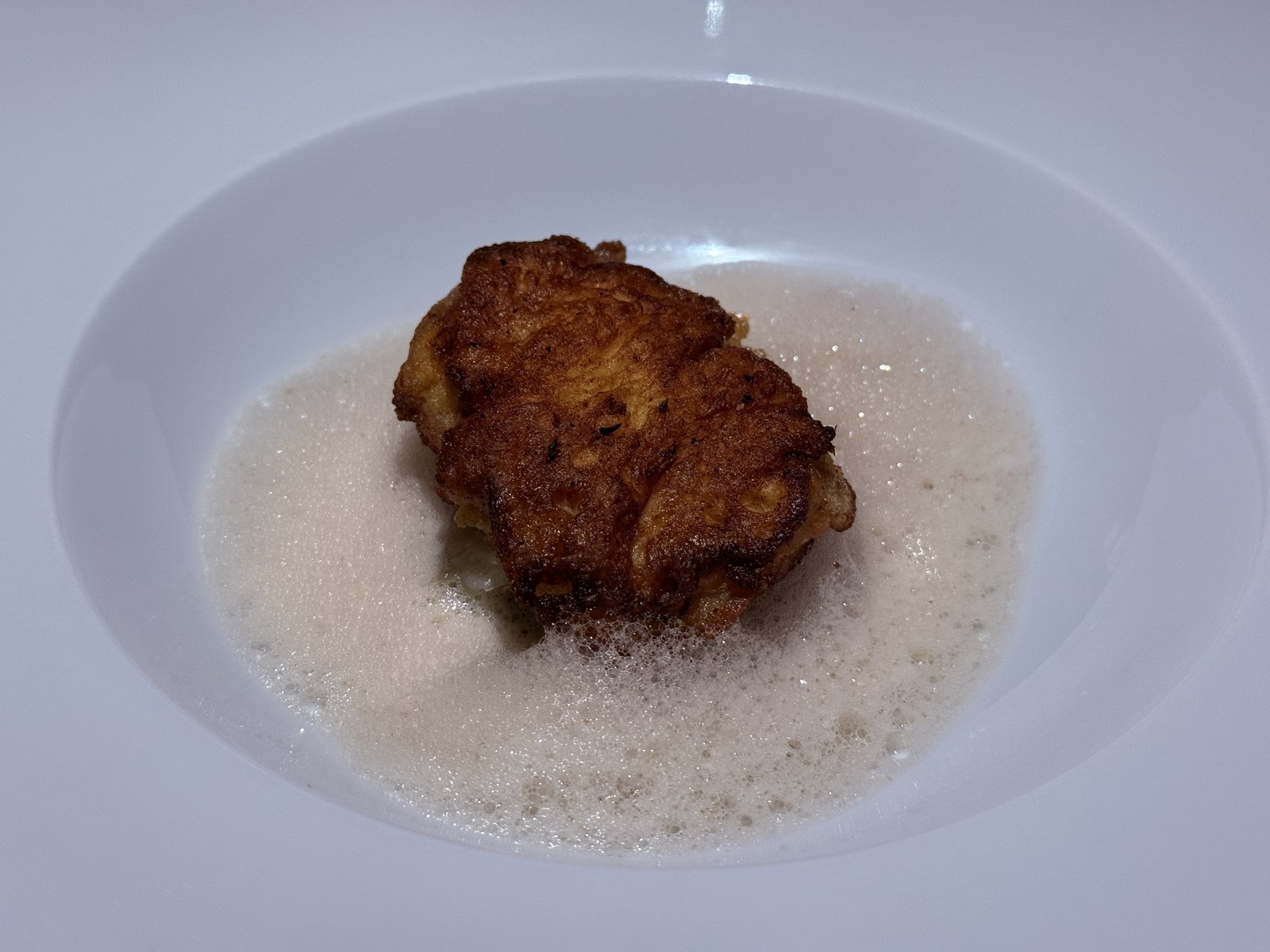
The texture: crispy egg-batter exterior, flaky white monkfish inside, umami-rich dashi base. The fennel adds anise sweetness. This is the dish that tells you the kitchen is paying attention to what’s happening in Tokyo and Copenhagen, not just Paris and Lyon.
Course 4 — Filet of Black Angus (The Hero)
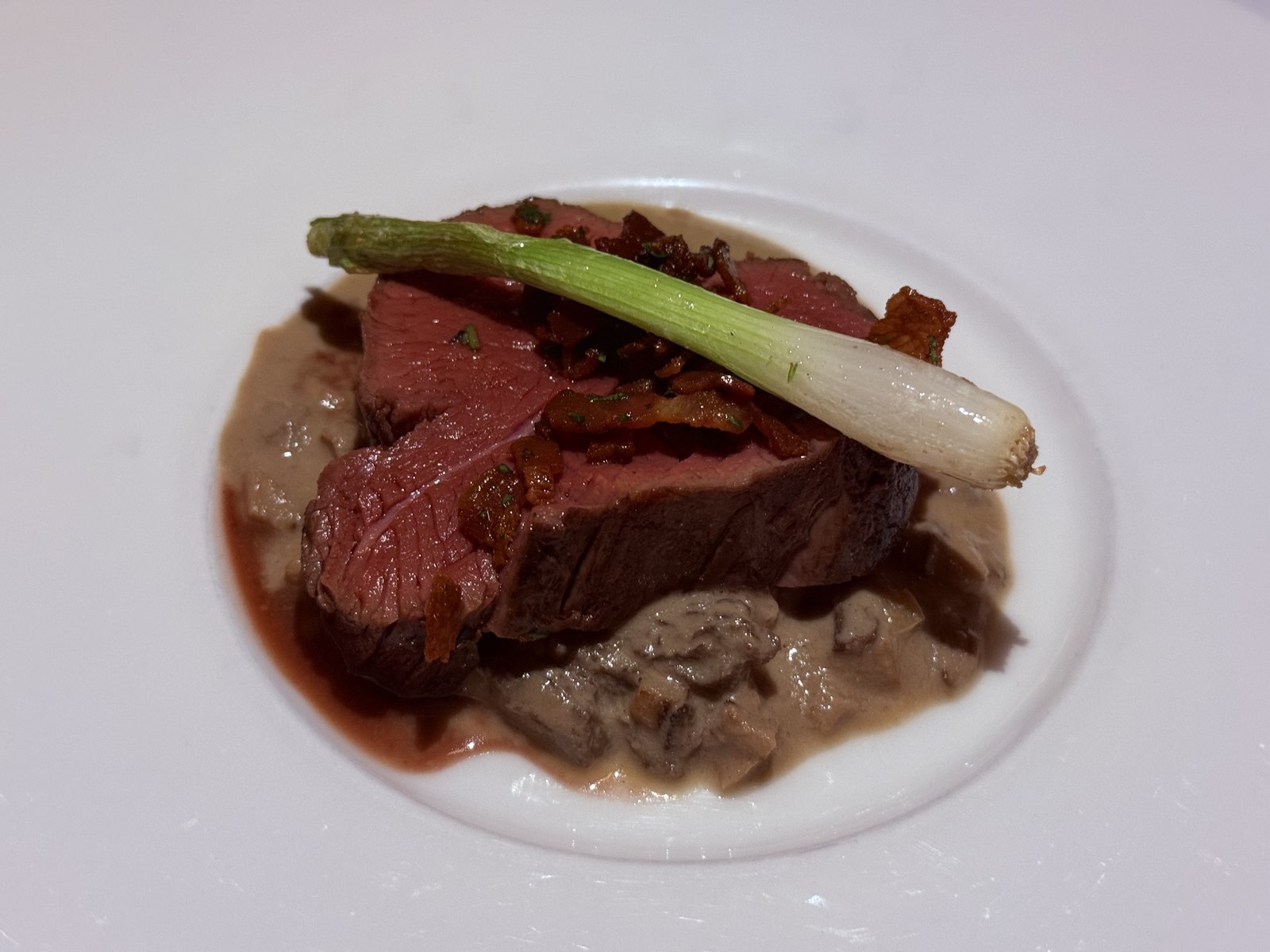
The meat course is the heart of the menu. A thick slice of rare-cooked Black Angus tenderloin sits on a bed of brown mushroom ragout, topped with crispy bacon crumbs and a single grilled baby leek, with a small red-wine jus pooled around the meat.
The technique: the beef is cooked low and slow to a perfect medium-rare, then briefly seared to lock in the bark. The center is pink, juicy, fall-apart tender. The mushroom ragout is a classic French sauce duxelles — finely-diced mushrooms, butter, white wine, reduced to a paste. The bacon adds salt-crunch contrast. The leek adds smoke and a vegetal anchor.
Pair with the Blaufränkisch Vitikult — Austrian red with the right tannin structure for the beef. The wine handles the meat’s richness without overwhelming the mushroom layer underneath. This is the course that justifies the whole evening.
Course 5 — Gâteau Basque with Apricots
The first dessert is a regional French classic from the Basque country. Gâteau Basque is a traditional tart with almond-flour-based pastry crust filled with vanilla pastry cream or cherry preserve. Duchardt does the cream version, served as a rectangular slice with a golden-caramelized top, accompanied by poached apricot compote as the fruit element.
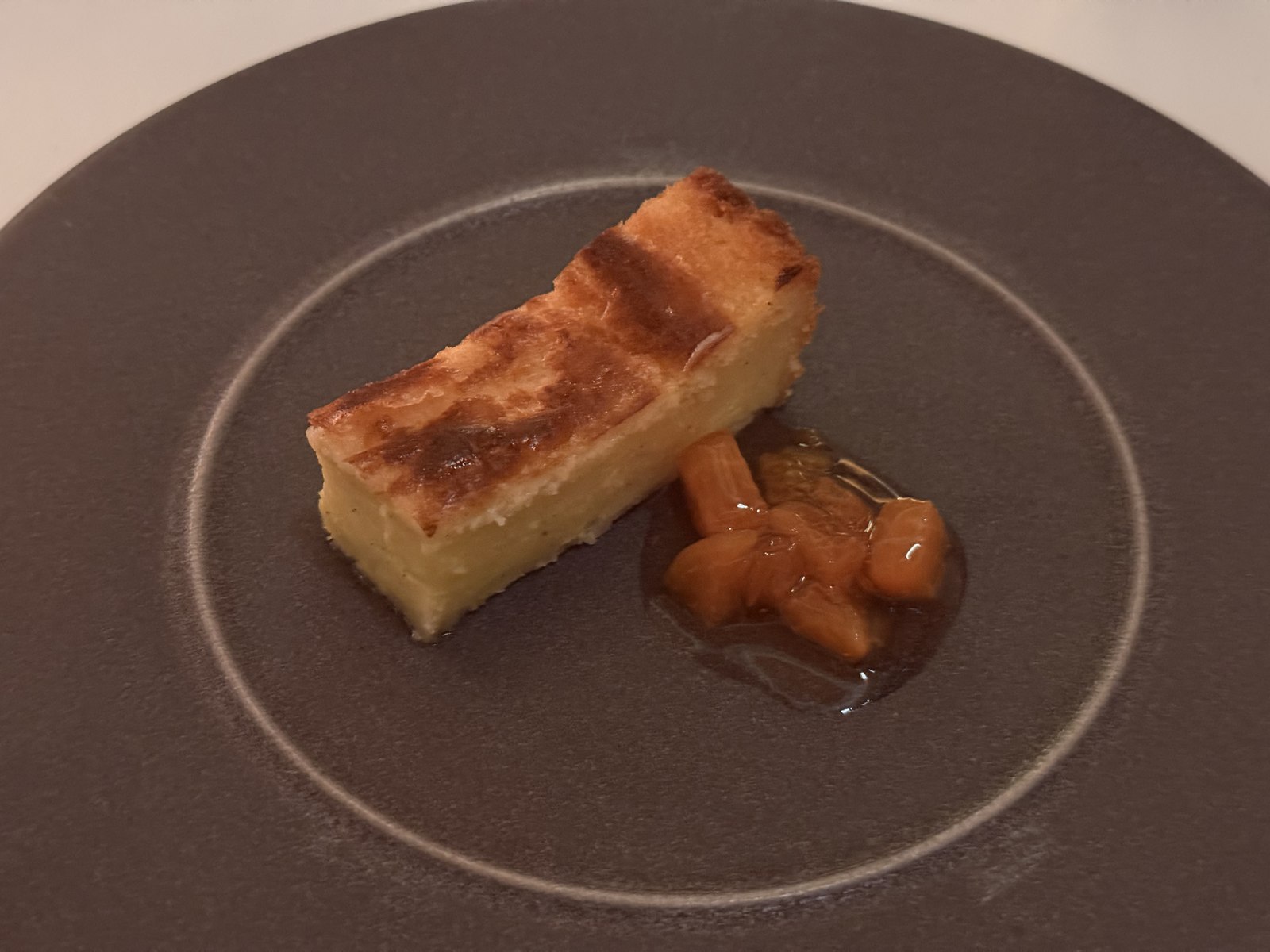
The cake is dense, almond-buttery, slightly sweet. The apricot compote adds bright stone-fruit acidity that cuts the cake’s richness. Cut a small piece of cake, drag through the compote, eat together. This is a regional French dessert that Vienna fine-dining rarely attempts — it requires the right baker and the right respect for the tradition.
Course 6 — The Closing Pastries
The meal closes with petit fours / mignardises — Duchardt sends a small square plate of four miniature canelé-style dark-caramel pastries, each one a tiny architectural piece with a glossy caramelized exterior and soft custardy rum-vanilla interior. (Some evenings the kitchen sends a chocolate tart in place of, or alongside, these closers — both are on the menu rotation.)
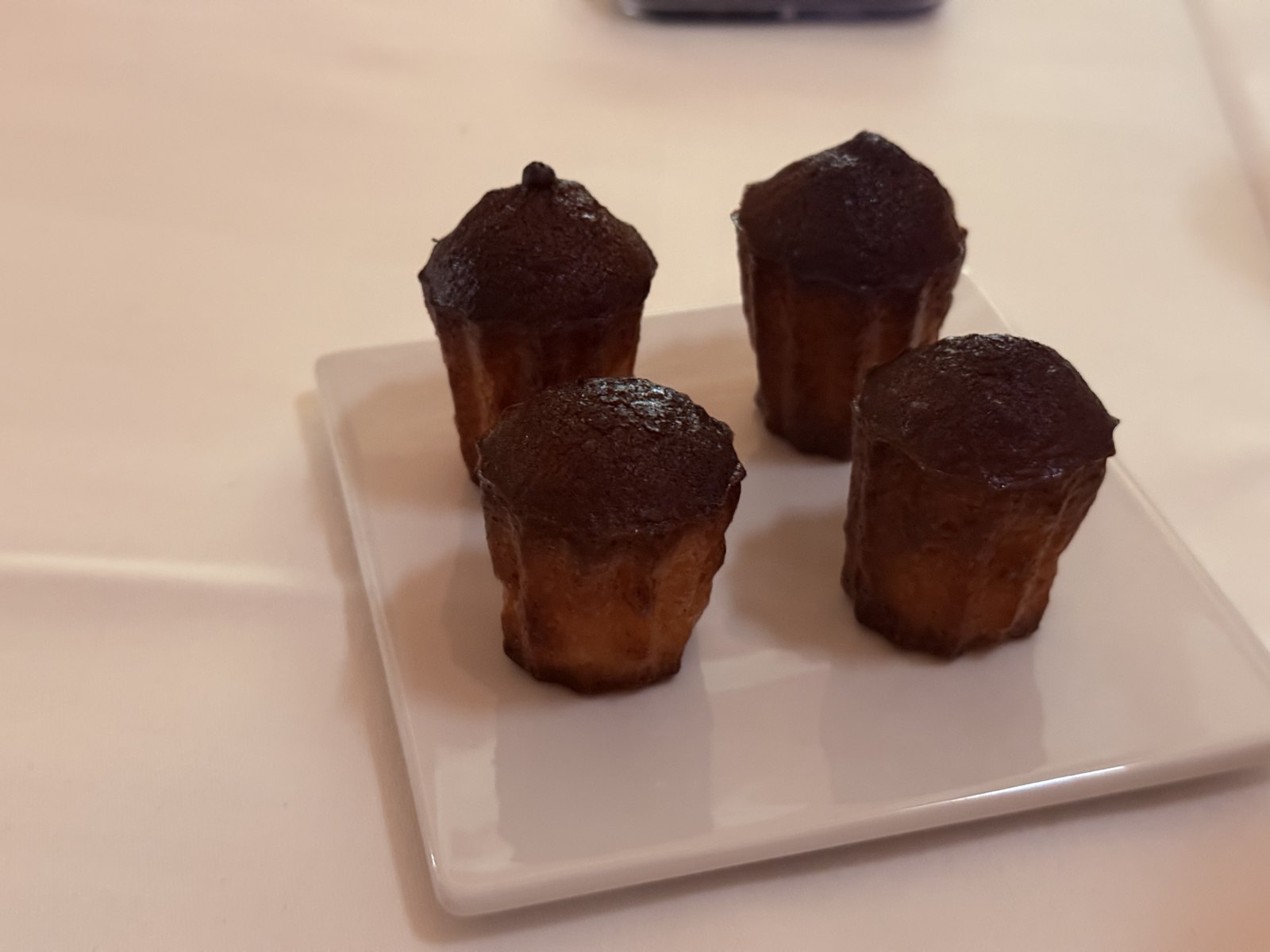
Eat with espresso. The bitterness of the coffee balances the deep caramel of the pastries. This is the natural conclusion of the meal — not another statement course, but a small sweet farewell.
Practical Notes for Vienna Travelers
- Reservations essential — only ~30 seats. Book 5-7 days ahead for weekends, 2-3 days for weeknights. Phone (Vienna numbers work from abroad) or online.
- Allow 2.5-3 hours for the full Chef’s Menu with wine pairing. Don’t book this if you have an early-morning flight.
- Wine pairing is the move — the standalone Chef’s Menu is fine, but the pairing elevates the experience. Add it when you book.
- Cards accepted everywhere (Visa / Mastercard / AMEX / contactless). No cash needed.
- 10% tip standard in Vienna fine-dining, 12-15% for exceptional service. Round to whole euros for cash, or write into the card total.
- English-friendly — bilingual menu, sommelier speaks English, all front-of-house multilingual.
- Dress code: smart casual minimum. Jacket appreciated. No shorts, athletic wear, or flip-flops.
- Pair with other Vienna restaurants: for a Korean meal in Vienna, see YORI Vienna (3 min walk away). For Vienna’s famous American-style BBQ ribs popular with Korean tourists, Ribs of Vienna. Compared to Korean fine-dining standards, Naedang in Busan is the closest equivalent format.
The Verdict
Restaurant Duchardt is the Vienna restaurant for the meal where everything matters. The kitchen has French classical training, the wine list has the Austrian native-grape literacy, the service is intimate without being theatrical, and the room’s QlockTwo word-clock is the kind of intentional design detail that signals what the rest of the meal will feel like. The Chef’s Menu format strips away choice and replaces it with trust. The 6 courses are traditional where they should be (paté en croûte, gâteau basque) and modern where it counts (monkfish in dashi). The Austrian wines pair so well with the French food that you stop noticing them and start trusting them. Book 5 days ahead, wear a jacket, order the wine pairing, take three hours over it. Strong recommendation — Vienna anniversary-dinner-tier.
| 🍽️ Food | 4.5 | |
| 💰 Value | 4.0 | |
| 🌏 Foreigner-friendly | 4.0 | |
| 📍 Access | 3.0 |
| Best for | Vienna anniversary dinner · special occasion · French-cuisine lovers · slow tasting evening · wine pairing experience |
| Order this | The Chef’s Menu (6 courses) · add the wine pairing (Crémant + Grüner Veltliner + Blaufränkisch) · reserve a window-side table |