- 내당 (Naedang, “Inner Hall”) — the Korean fine-dining restaurant inside a 5-star Busan hotel, doing serious modern Korean court cuisine.
- The 라 코스 (Ra Course / La Course), 9 courses for ₩110,000 ($75), runs from morel tarakjuk and persimmon caviar to cedar-steamed lobster, hanwoo tteokgalbi, and the Naedang signature hanwoo hot pot.
- The kind of meal you book for an anniversary, a wedding rehearsal, or your parents’ 60th birthday. Visited 2026.
In a quiet 5-star Busan hotel restaurant called 내당 (Naedang) — “Inner Hall” — chef plates Korean hanjeongsik one course at a time, slow and considered. This is the Busan room for milestone meals: 9 courses unfold over about 2 hours, and the rice arrives 7 courses in, because by then you’ve earned it.
Visited: Saturday, May 30, 2026 · Where: Hotel Nongshim, Oncheon-dong, Dongnae-gu, Busan · What I ordered: Ra Course (9-course tasting menu), ₩110,000 ($75 USD) per person, runs about 2 hours · How I paid: Out of pocket (내돈내산 / not sponsored, no PR invite)
I came specifically for the Ra Course tasting menu — the kitchen’s full range, the proper introduction to what Naedang does. The meal opens with a cold trio that signals the seasoning philosophy: restrained, ingredient-forward, less sauce-driven than typical Korean restaurant fare. Salt and acid sit just behind the natural sweetness of the produce.
Two courses worth flagging for first-time visitors: the morel-cream tarakjuk early in the sequence (a soft, almost dairy-sweet porridge with deep mushroom umami), and the abalone-rice porridge near the end (a quiet, restorative dish that Koreans associate with home recovery food). The rice course arrives seven plates in — a deliberate signal that the meal is past its middle and into its grounded second half.
| 📍 Where | Inside a 5-star hotel, northern Busan (Geumjeong / Dongnae area) — see Google Map below |
| 🕒 Hours | Lunch 12:00–15:00 · Dinner 18:00–22:00 · closed in line with hotel schedule |
| 💰 Price | 라 코스 (Ra Course) ₩110,000 ($75 USD) per person · 9-course tasting menu · à la carte and shorter courses also available · kids’ set available |
| 📖 English menu | Yes — full English/Korean menu card · staff trained in English (and other languages) service |
| 💳 Cards | All major cards · Visa / Mastercard / AMEX / 国内 cards |
| 📞 Reservation | Reservations strongly recommended · especially weekends and holidays · book through the hotel concierge or by phone |
| 👔 Dress | Smart casual · no shorts/tank tops · jacket appreciated at dinner |
| 🎂 Occasions | Excellent for weddings, 돌잔치 (first-birthday), 환갑잔치 (60th birthday), anniversaries · private rooms available |
Cultural anchor for foreign visitors: 한정식 (hanjeongsik) is the Korean banquet meal format — a long sequence of small dishes built around rice, soup, and meat, with cold and hot courses, banchan, fermented sides, and dessert. 라 코스 (Ra Course) is the modern Korean fine-dining packaging of that tradition — a fixed-price tasting menu, plated one course at a time, French-restaurant style. “La Course” in French; “라 코스” in Hangul. Korea has been re-engineering hanjeongsik into Michelin-level tasting menus over the last 15 years, and hotel restaurants like Naedang are where the format is most polished.
The Spot — A Korean Hall Inside a Busan Hotel
Naedang sits on the upper restaurant floor of the hotel — a quiet hallway, soft Korean instrumental music, a hostess station in dark wood. The dining room itself is calibrated for a special-occasion meal: linen-on-linen tables, ceramic chopstick rests, low lighting, hand-painted Korean folk screens on the walls. Private rooms with sliding doors line one side for family gatherings — the kind of room you book for a 돌잔치 (dol-janchi, first birthday), a 환갑잔치 (hwangap, 60th birthday), or a wedding rehearsal.
The Menu — The 라 코스 (Ra Course)
Three menus are offered — the flagship Ra Course, a shorter course, and à la carte. The Ra Course is the one to order if you came for the experience. Nine courses, ₩110,000 ($75 USD) per person, runs about 2 hours. The menu card arrives at the start — Korean on top, English underneath, beautifully printed.
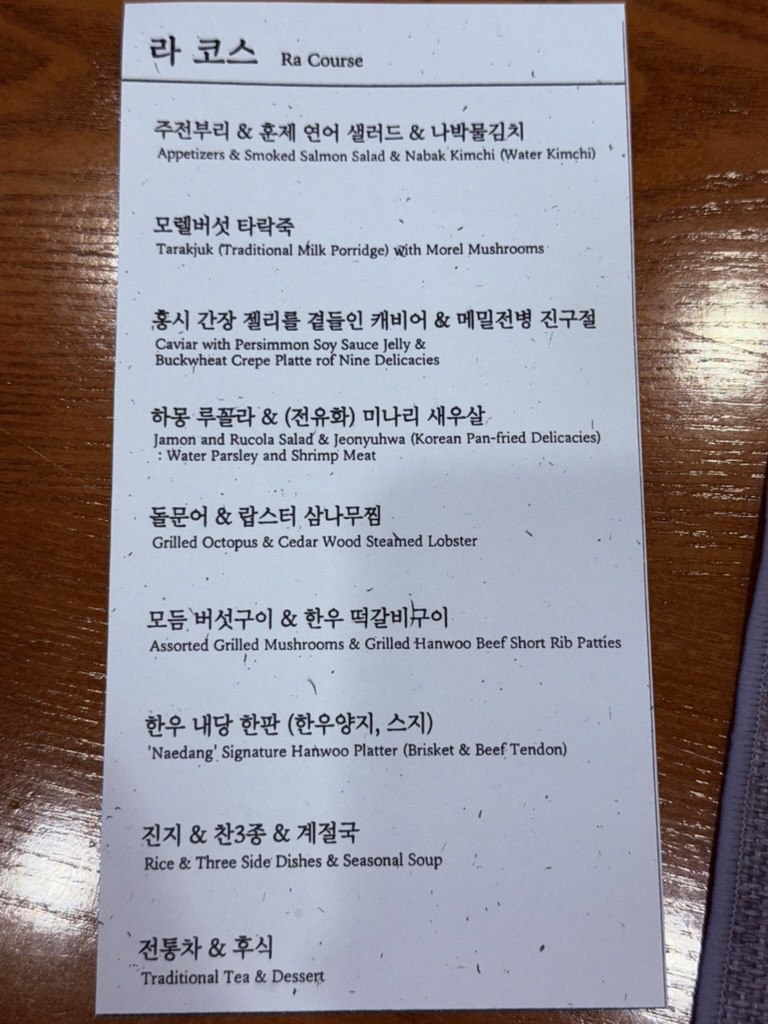
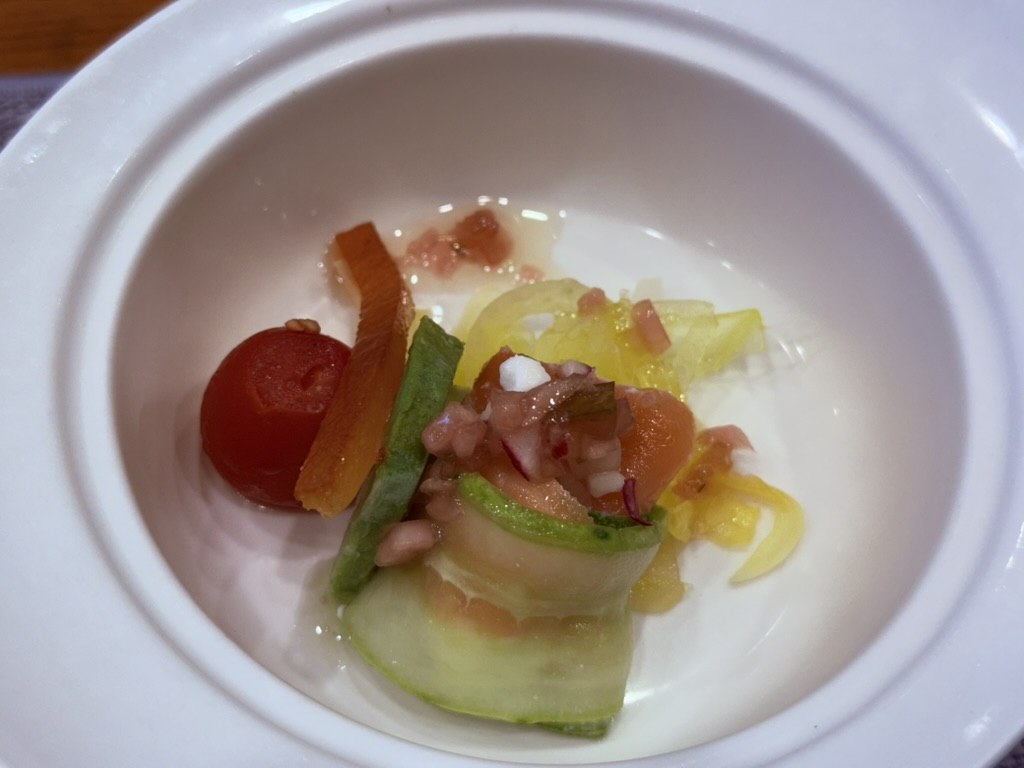
Course 1 — Appetizers, Smoked Salmon Salad & Nabak Water-Kimchi
The first course is a cold trio. A small white bowl arrives with a poached cherry tomato (skin removed), a ribbon of cucumber and yellow paprika wrapped into a small cylinder, julienned carrot, and a salsa of finely-diced apple and tomato with a hint of nabak-mul-kimchi (나박물김치, mild water kimchi) brine. Bright, faintly sour, palate-opening — exactly what the first cold course of a hanjeongsik should be.
Course 2 — 모렐버섯 타락죽 (Morel Mushroom Tarakjuk)
타락죽 (tarakjuk) is one of the rarest dishes in modern Korean cuisine. It’s a traditional milk-and-rice porridge from the royal court of the Joseon Dynasty — rice milled and slowly cooked in cow’s milk into a silky, lightly-sweet, ivory-coloured soup. Court cooks made it for the king as a morning meal. Today maybe three or four restaurants in Korea still make it. Naedang’s version is finished with a small spoonful of finely-diced morel mushroom and a dot of fermented black-bean reduction in the center.
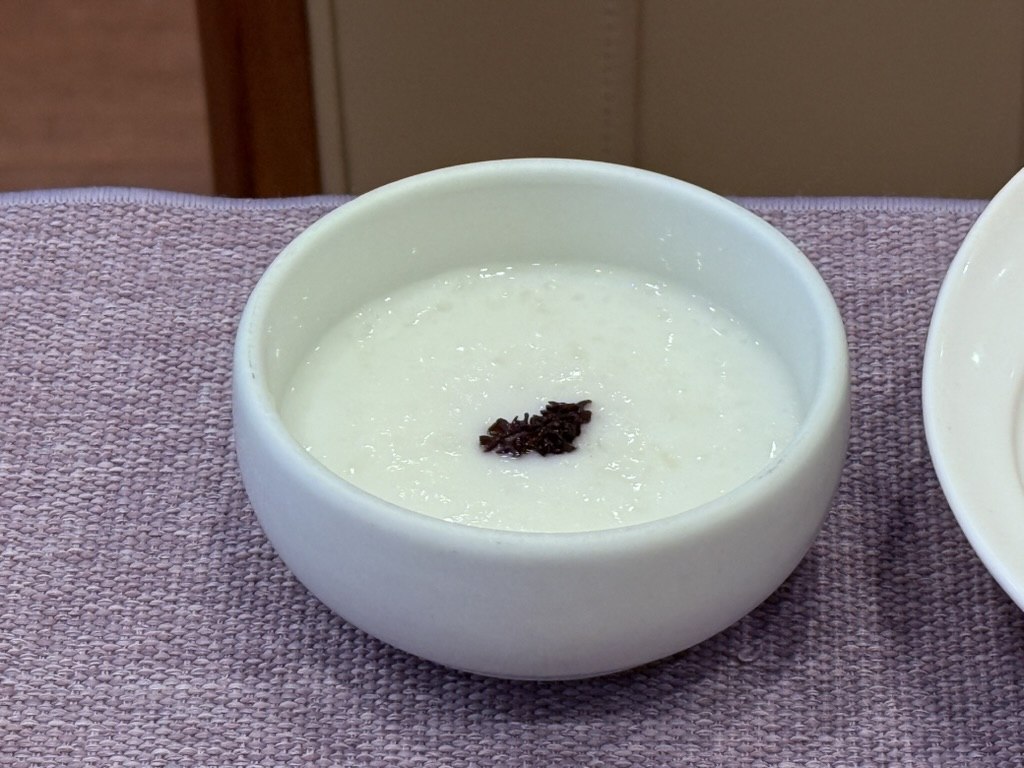
The flavor is gentle, almost dairy-sweet, with the morel’s deep-earth umami coming through a beat later. It’s a dish that can only exist in this kind of restaurant — labor-intensive, ingredient-rare, and only worth doing when you have an hour to spend on a single course.
Course 3 — Caviar & Buckwheat Crepe with Nine Delicacies
The third course is a dual plating — the modern half on one plate, the traditional half on another.
3a — Caviar with Persimmon Soy-Sauce Jelly
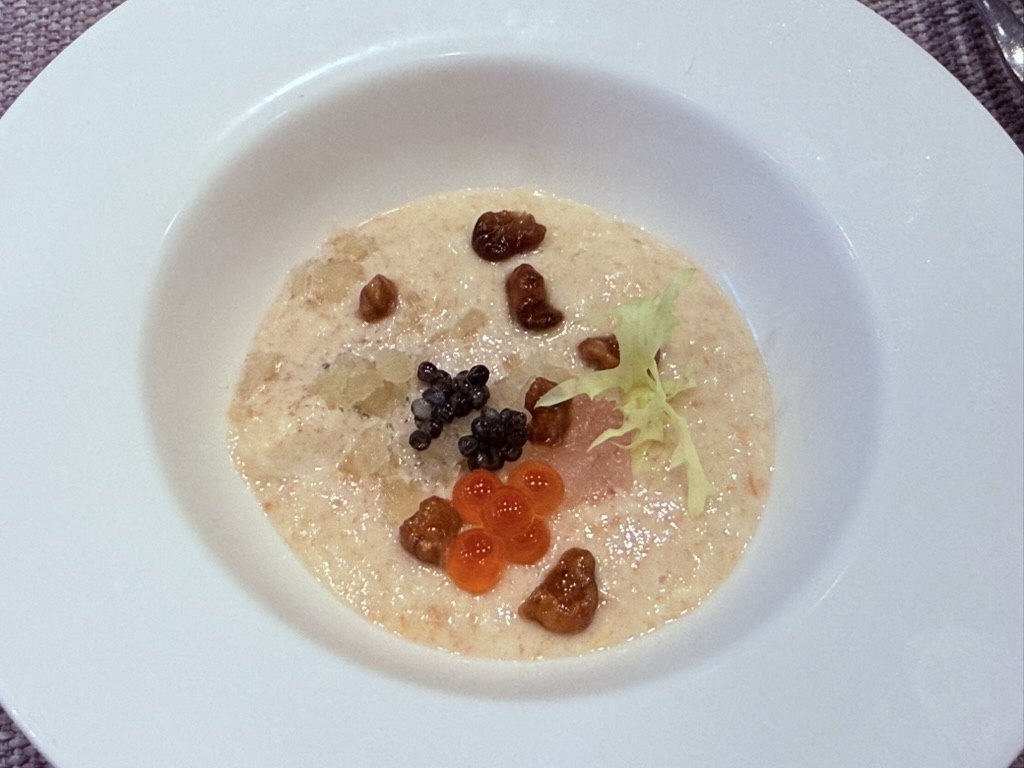
On a wide white plate, a creamy seafood velouté base is topped with a constellation of small jewels: black caviar, orange salmon roe, candied walnuts, smoked salmon, diced persimmon, fresh endive, and a soy-sauce jelly cut from cold. The Korean-French move here is the 홍시 간장 젤리 (hongsi-ganjang jelly) — a setting of soy sauce stabilized with sweet ripe persimmon, cut into clear cubes. The combination of caviar saltiness, salmon-roe pop, persimmon-soy sweetness, and walnut crunch is what the kitchen does best — restrained, balanced, not over-thought.
3b — 메밀전병 진구절 (Buckwheat Crepes with Nine Delicacies)
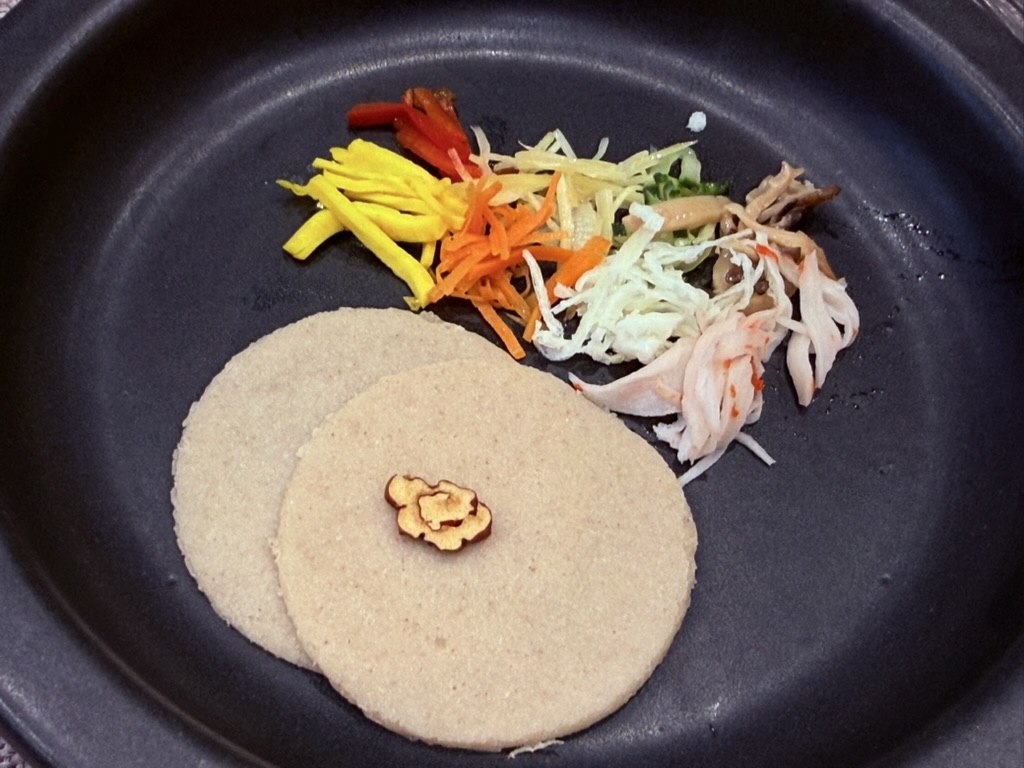
On the second plate, two small buckwheat crepes (메밀전병) — pale beige, soft, the size of a coaster — sit beside a small pile of nine julienned fillings: yellow squash, red pepper, carrot, white cabbage, crab meat, mushroom, beef tendon, beansprout, and chive. This is the Naedang interpretation of 구절판 (gujeolpan), the iconic royal-court nine-section tray. Take one crepe, layer in your own combination of fillings, fold it like a small Korean taco. The point of gujeolpan is composition — every diner builds their own crepes, no two bites the same.
Course 4 — Jamon & Rucola Salad + Jeonyuhwa Shrimp
A Korean-Spanish fusion course. The classic Korean dish here is 전유화 (jeonyuhwa) — a generic term for batter-dipped, pan-fried delicacies, the kind that appear on every Korean holiday table. Naedang turns it into a single golden disc — shrimp folded with minari (water parsley) and bound in a thin egg-and-flour batter, pan-fried until the edges crisp — and then crowns it with a rocket-and-jamon salad and sesame seeds, like an Italian tagliata.
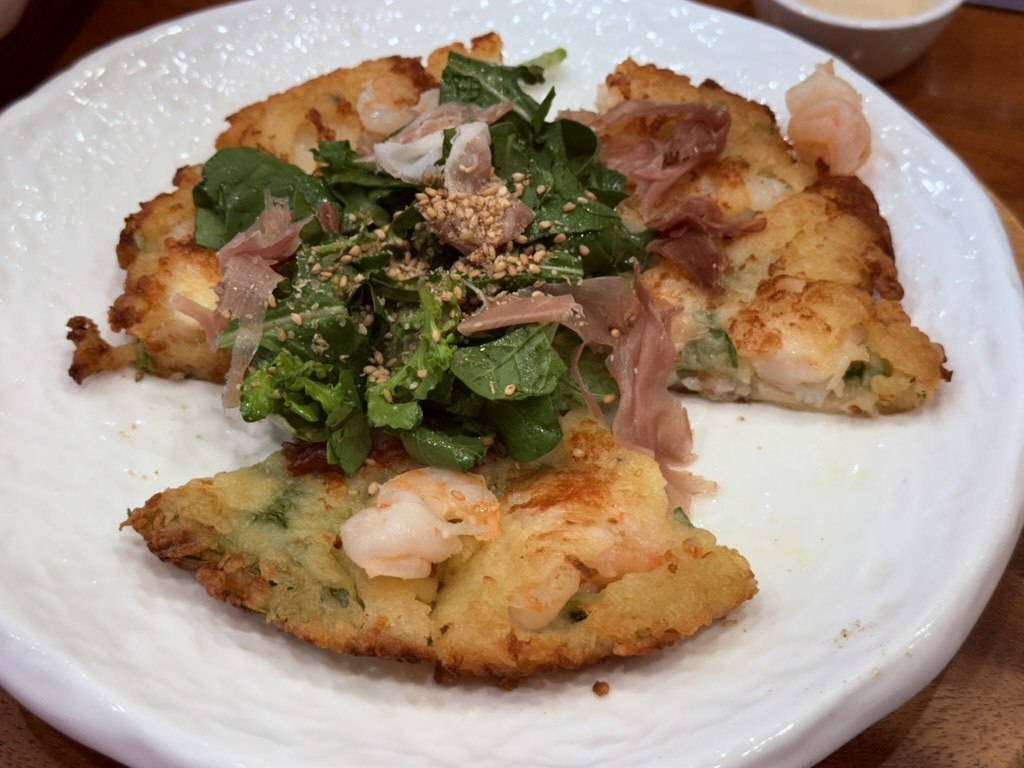
The pancake is delicate, almost custardy, the shrimp still snapping. The jamon adds salt-cured pork depth that shouldn’t work with Korean jeon but absolutely does — a year of cured-meat saltiness against the soft fried shrimp is the move. The rocket adds bitter green to cut everything. This is the dish where you realize the kitchen is doing modern Korean, not nostalgia.
Course 5 — Cedar-Wood Steamed Lobster & Grilled Octopus
A wooden cedar-wood box arrives at the table. The waitress lifts the lid — a cloud of cedar smoke rises off the seafood underneath. Inside: lobster tail meat (the shell included for presentation), grilled-then-battered octopus chunks, a small bowl of chojang (Korean cocktail sauce with gochujang and vinegar), pickled radish, and a few lettuce-and-crab-meat cups. The cedar perfumes the lobster while it steams — that resinous, just-cut wood smell on shellfish is the technique most associated with the Pacific Northwest, but Korean fine-dining has been adapting it for the last decade.
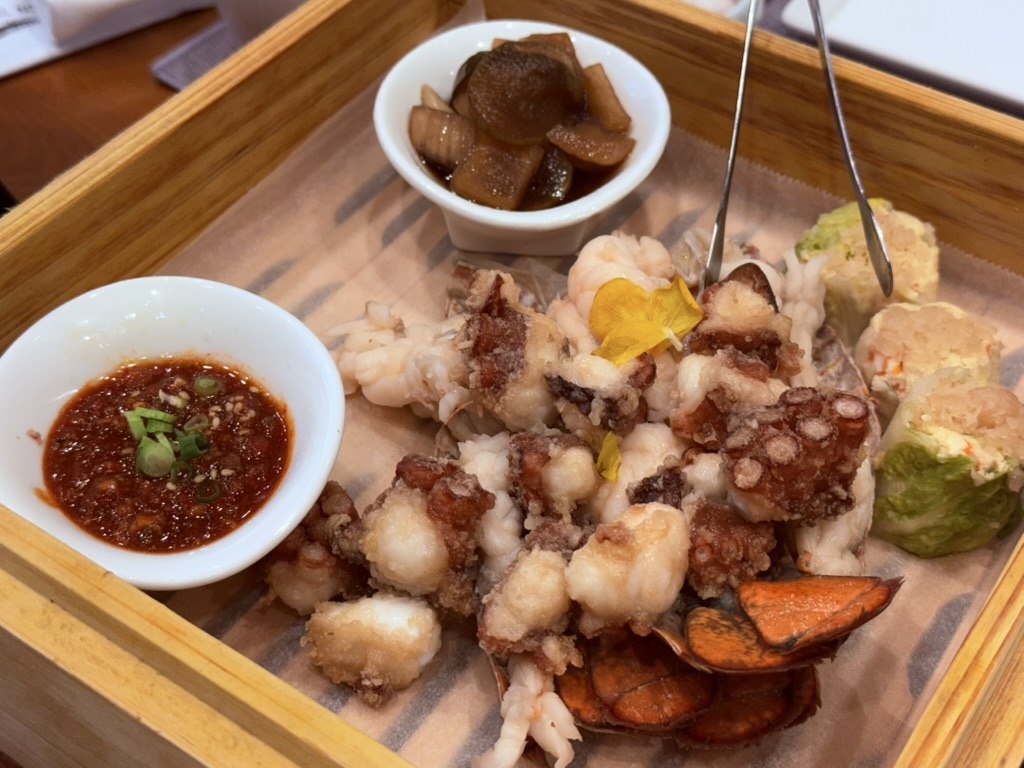
The lobster is just-set, still-bouncy, perfumed. The octopus is the surprise — flash-grilled then dipped in a thin tempura batter and fried for thirty seconds, so the outside is crisp but the inside is barely-cooked, still snapping. Dip the lobster in the chojang. Wrap an octopus piece in a lettuce cup. Order a glass of crisp Korean rice wine to drink along with this one.
Course 6 — Assorted Mushrooms & Hanwoo 떡갈비
떡갈비 (tteokgalbi) is the Korean grilled beef patty — minced hanwoo (Korean cattle) seasoned with soy, pear, garlic, and sesame oil, shaped like a small disc, grilled over charcoal. The dish originally came from Joseon-Dynasty palace cuisine — beef was scarce, so cooks minced what they had and grilled it on the bone. Naedang serves two perfect tteokgalbi on a white plate, alongside king-oyster, shiitake, and beech-mushroom medley grilled with garlic and a finish of green herb-oil, with a side of shaved-daikon salad topped with crispy-fried leek hair (대파튀김).
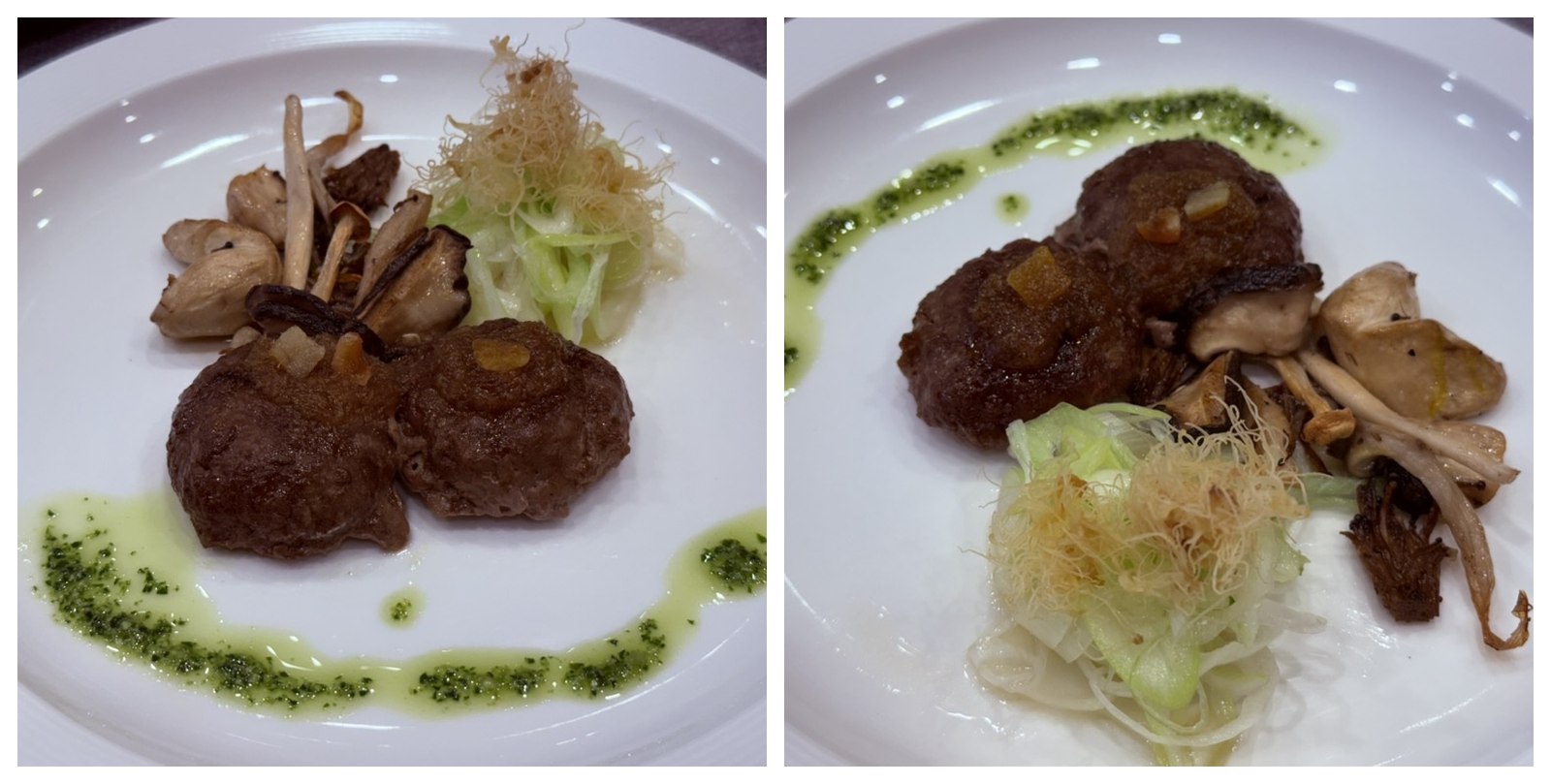
The tteokgalbi is the test of the meal. At a bad restaurant it’s dry and one-note. Naedang’s is melt-tender, still-juicy in the center, the seasoning balanced so the hanwoo’s natural marbling sweetness leads and the soy-garlic supports. The crispy leek garnish on top — 대파튀김, a fine julienne of leek hair fried at low temperature until it turns into a sweet sugar-crisp nest — is the kind of small detail that signals the kitchen cares.
Course 7 — 한우 내당 한판 (The Signature Naedang Hanwoo Platter)
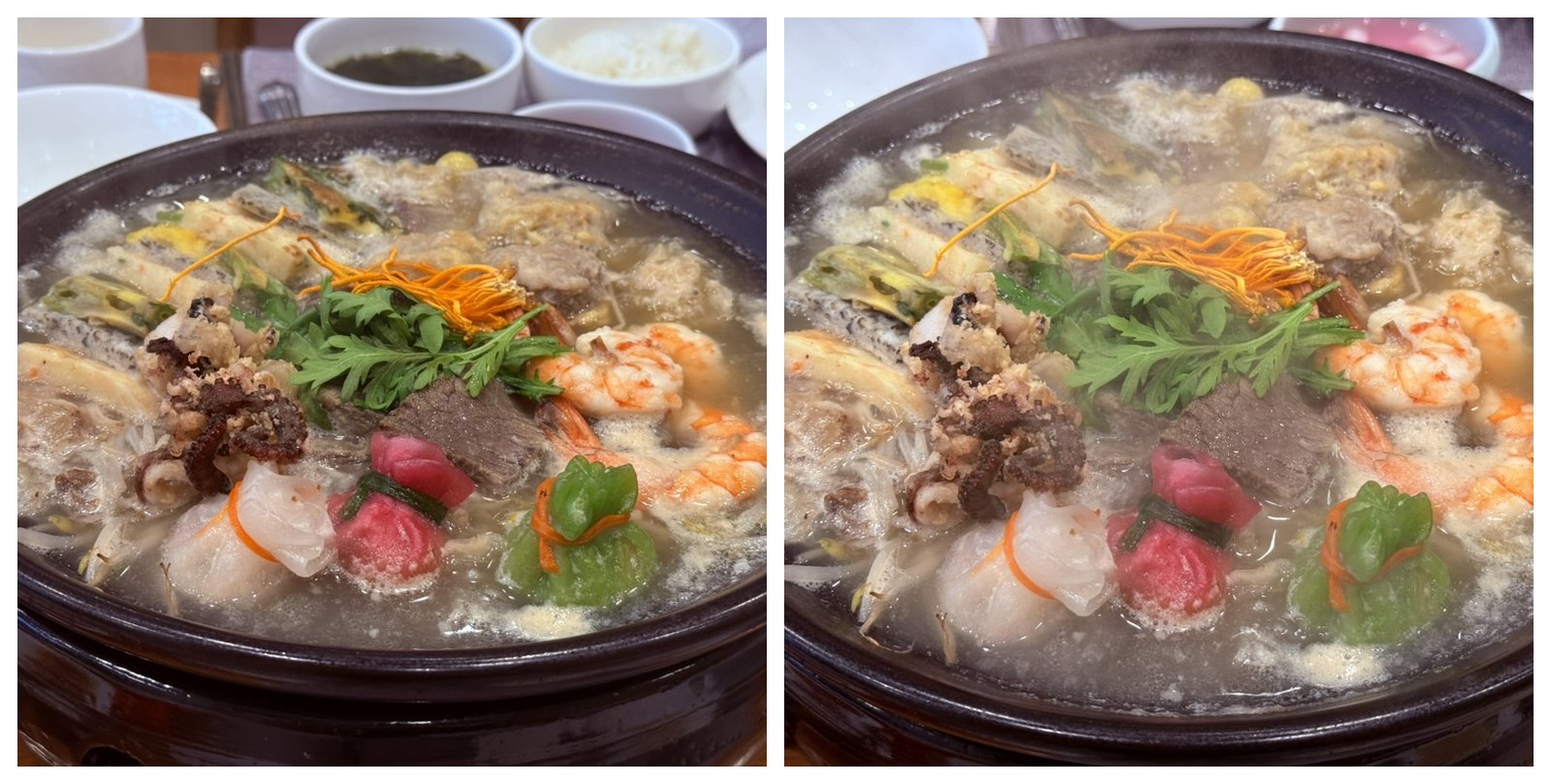
Then the signature dish arrives. 한우 내당 한판 — literally “Naedang’s Hanwoo Plate” — is the restaurant’s namesake course. A large black clay pot with a clear, mineral-bright broth, set on a portable burner that keeps it just-simmering at the table. Inside: hanwoo brisket (양지) and beef tendon (스지) slow-cooked for hours, plus shrimp, octopus, scallop, colorful mochi tteok in red/green/white, mushrooms, chrysanthemum greens (쑥갓), and a saffron-colored garnish of marigold stamens in the center.
This is essentially a modern interpretation of 어복쟁반 (eobok-jaengban) — the Pyongyang-style sliced-brisket-in-broth that defined Korean banquet cuisine in the early 20th century. Naedang adds the shellfish and the colored tteok for visual impact and varied texture. The broth has been cooking somewhere in the kitchen for the better part of a day. You ladle some into a small bowl, take a spoonful — clean, mineral, deeply beefy, with a sweetness from the tendon collagen that you only get from long cooking. The brisket falls apart at the touch of chopsticks. The tendon turns to gelatin. The shrimp are fresh enough to snap.
This is the moment of the meal — the one you remember the next morning. Slow down here.
Course 8 — Rice, Three Sides, Seasonal Soup
The hot pot leaves enough of itself behind that the rice course feels like a coda, not a separate dish. A small bowl of glossy short-grain rice, glistening from the rice-cooker steam.
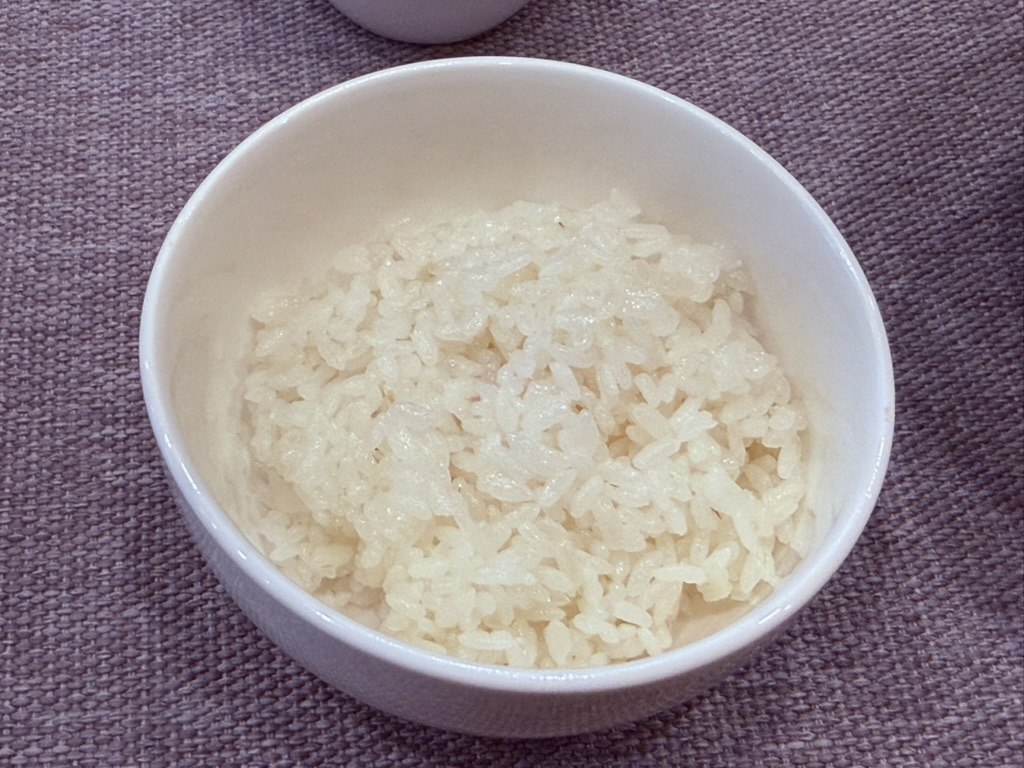
Three small banchan (반찬) are pre-set, all made in the Naedang kitchen — none of the wholesale-supplier-banchan you get at mid-tier hanjeongsik places.
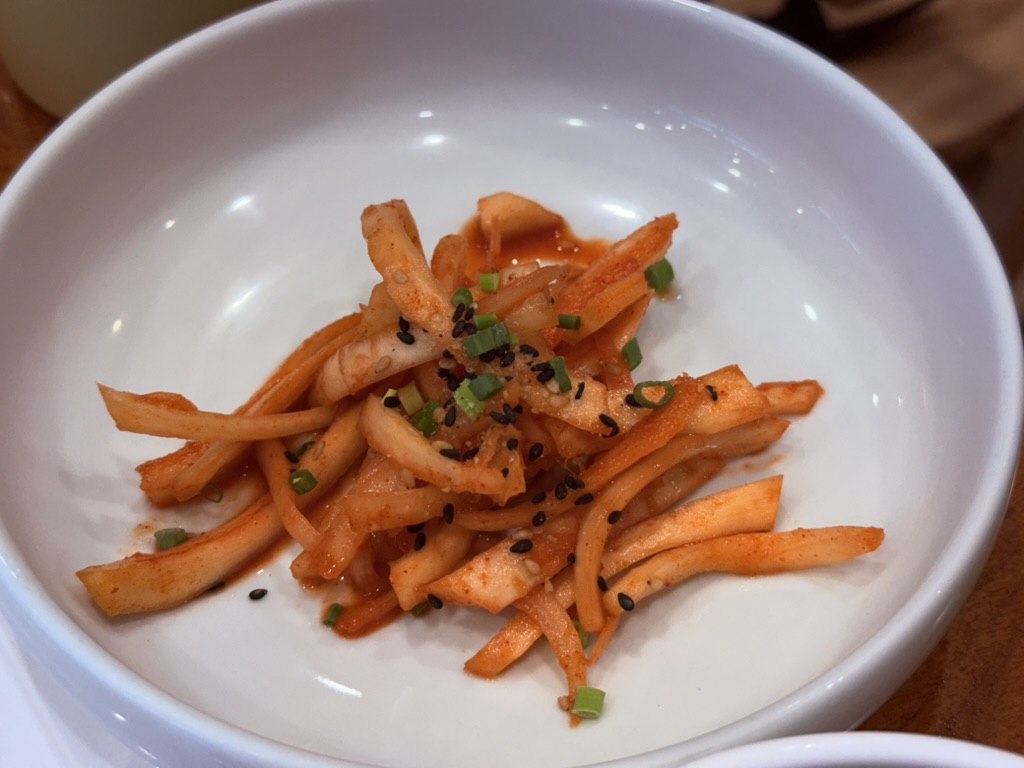
무생채 (Mu Saengchae) — Spicy Radish Salad
Julienned daikon radish, dressed in gochugaru (Korean chili flakes), fish sauce, sesame, and minced scallion. The radish keeps its crunch. The chili is bright, not aggressive. Eat half a chopstick-full with each bite of rice.
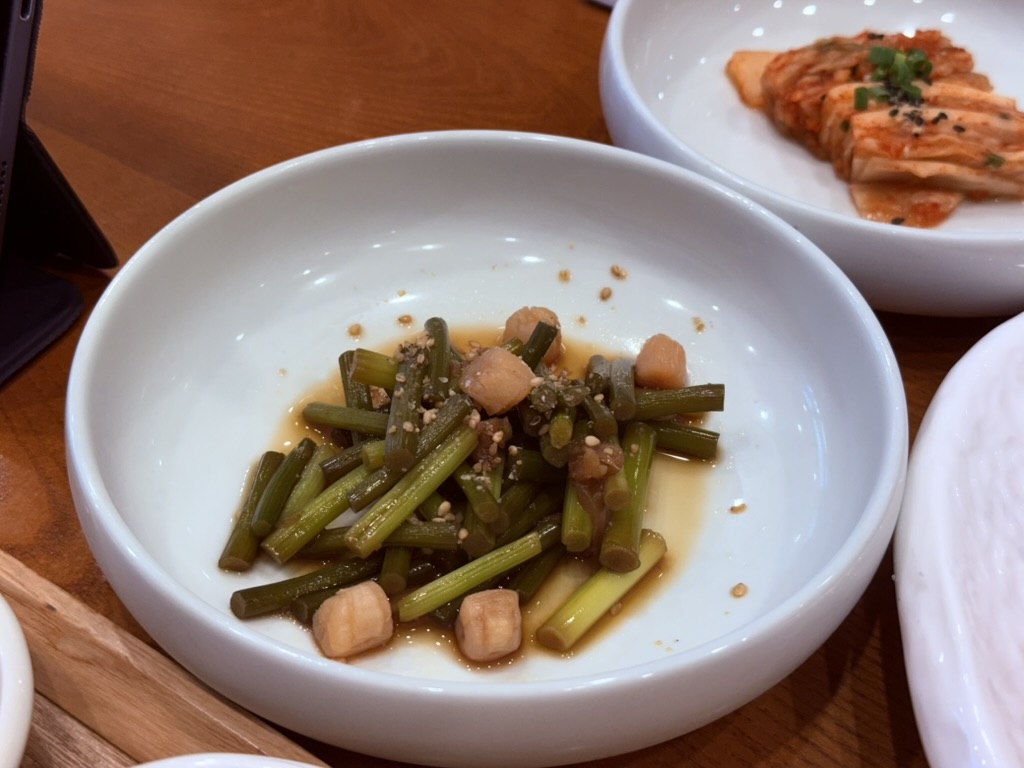
마늘쫑 무침 (Garlic Stems with Daikon Cubes)
Tender garlic-stem batonnets (마늘쫑) tossed in a light soy-vinegar-sesame dressing with small diced daikon cubes. Bright, garlicky, almost pickled. The kind of banchan that makes you want a second bowl of rice.
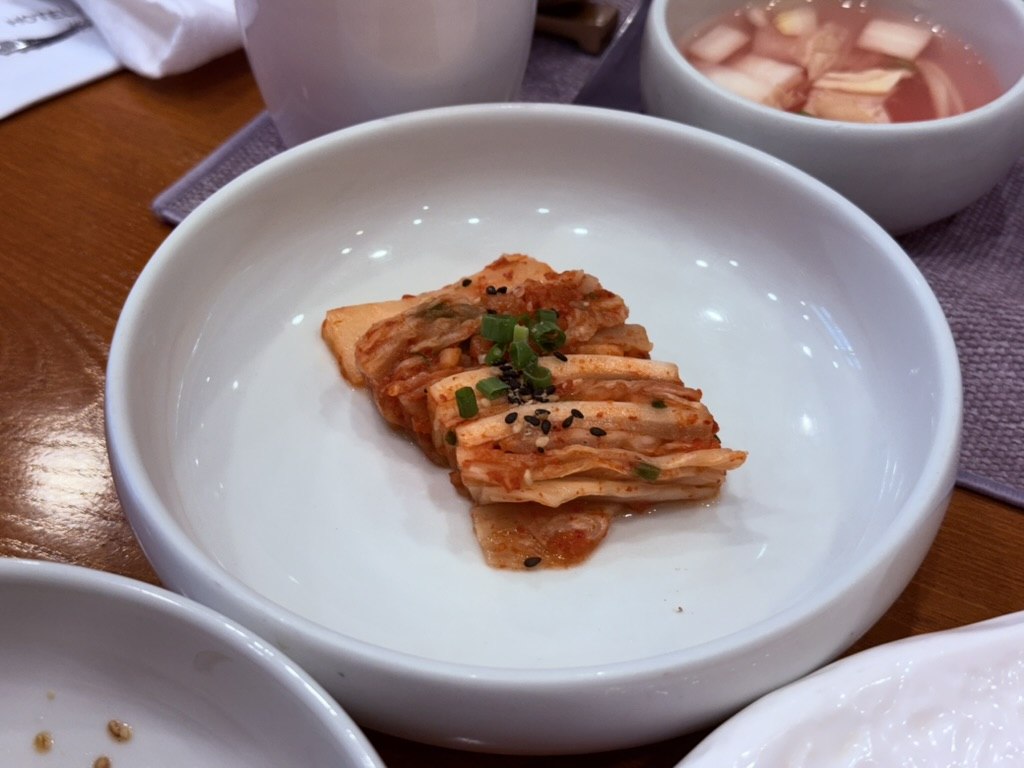
배추 김치 (Cabbage Kimchi)
A small portion of house-made cabbage kimchi — finely chopped, slightly aged, with a clean lacto-fermented sourness and visible chili-paste coating. Less aggressive than a banchan-restaurant kimchi, calibrated for the rest of the meal.
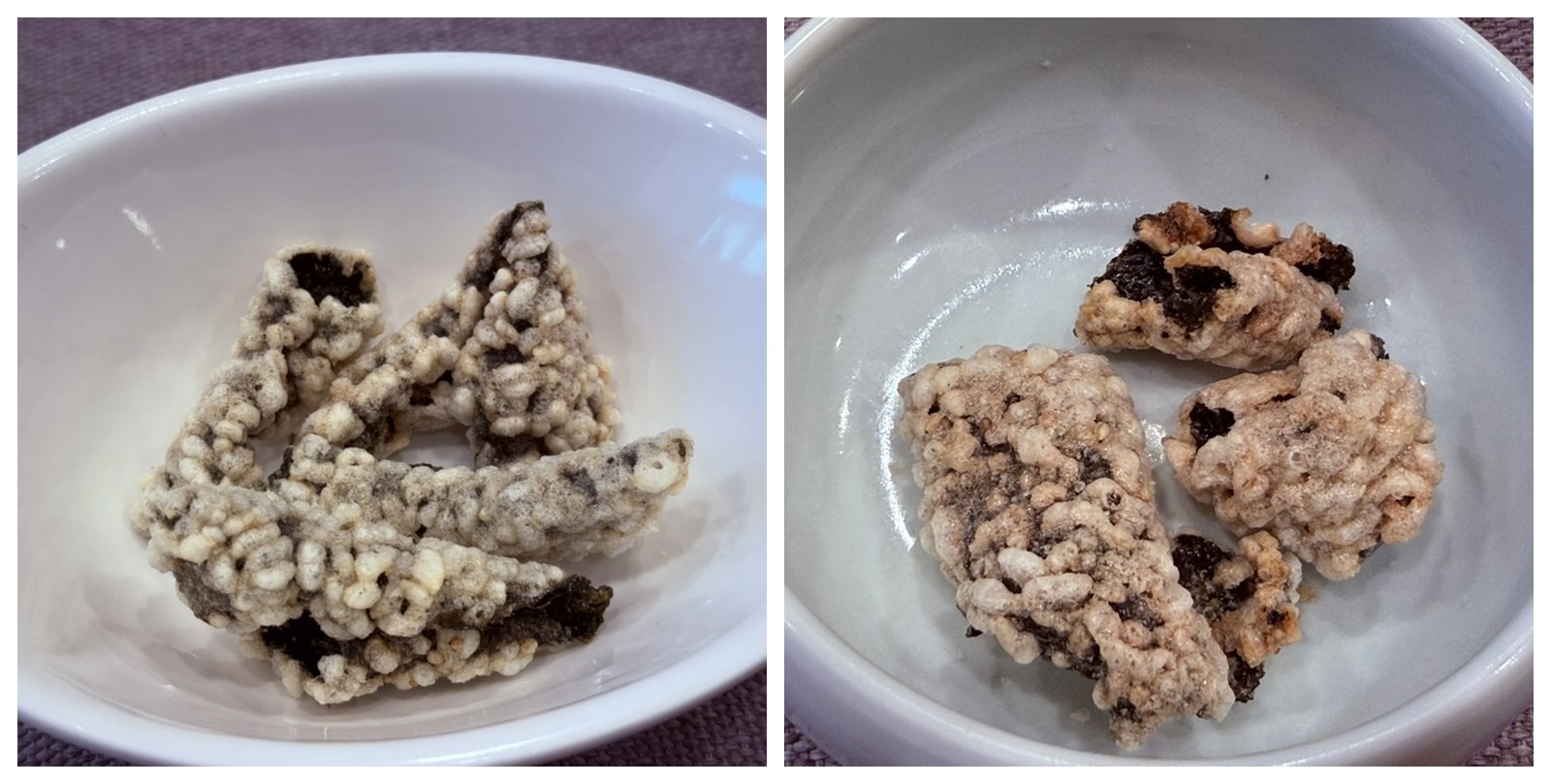
And throughout the meal, a small dish of 김부각 (gim-bugak) — a Korean royal-court snack of roasted seaweed (gim) sheets coated in glutinous-rice batter and deep-fried until they shatter at the touch. Best eaten as a crisp palate-cleanser between richer courses.
Course 9 — Traditional Tea & Dessert
The dessert tray closes the meal in the same hanjeongsik tradition. A wedge of cold melon (sweet, just-firm), a small red rice-cake (떡) (the size of a marble, faintly cinnamon-spiced — likely 경단, sweet-rice ball), and a small cup of warm chrysanthemum or yuzu tea.
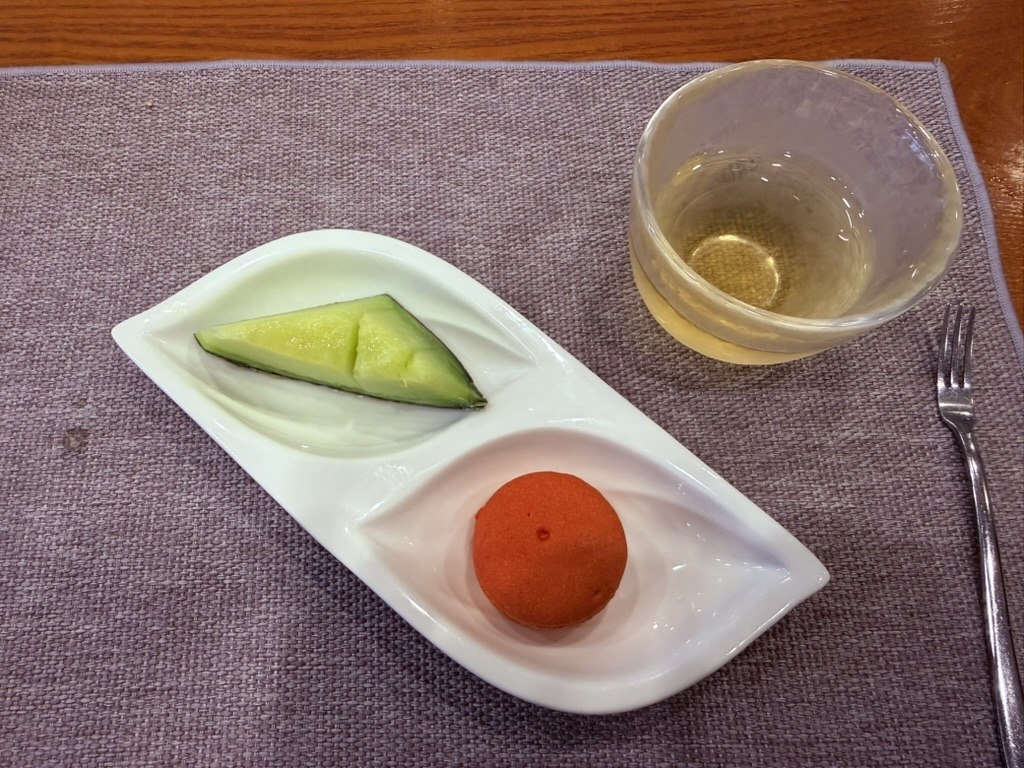
It’s a deliberately restrained ending — a refreshing palate-cleanse, not another statement dish — and exactly the right one after 8 courses of escalating complexity.
The Kids’ Course — Family-Friendly Fine Dining
One of the genuinely thoughtful things about Naedang is the kids’ set menu. While the adults work through the Ra Course, kids get their own plate of Korean-American classics: japchae glass noodles in a fried-rice-paper cup, mini donkkaseu (Korean pork cutlets), 미역국 (miyeokguk, seaweed soup), steamed-egg with shrimp, a small portion of tteokgalbi, and a bowl of rice — served with a LEGO-themed spoon. It’s the kind of small operational detail that turns a “we tolerate kids” restaurant into a “we plan for kids” restaurant.
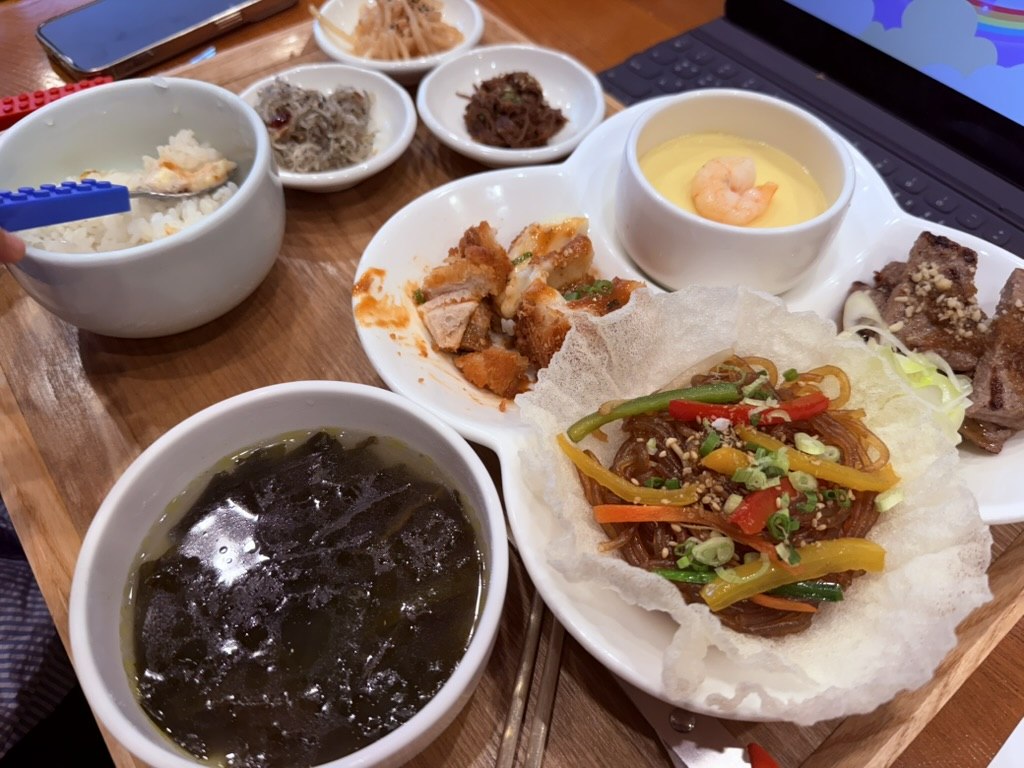
This is what makes Naedang the right pick for a multi-generational celebration — 환갑 (60th birthday), 돌잔치 (first birthday), wedding rehearsal — where you have grandparents, parents and small kids at the same table.
Practical Notes for Visitors
- Reservation strongly recommended — especially weekends, holidays, and the wedding season (March–June, September–October). Book through the hotel concierge.
- Allow 2 hours for the full Ra Course, with proper pacing between courses. Lunch or early dinner works best.
- English-speaking service is available — staff will explain each course, ingredient origin, and any dietary substitutions.
- Private rooms exist for groups of 4+ — ask when you reserve. Standard for 돌잔치 / 환갑잔치 occasions.
- Kids welcome — the kids’ set menu is excellent and the staff know how to pace it parallel to the adult course.
- Dress code: smart casual minimum. Jacket appreciated at dinner. No shorts/tank tops/flip-flops.
- Pair it with other Korean fine-dining benchmarks: in Seoul, Mugunghwa at Lotte Hotel Seoul is the comparable royal-cuisine flagship. On Jeju, Park View at Jeju Shilla offers the buffet-format equivalent. For Korean fusion, try Baesan Imsu in Samseong-dong.
The Verdict
If you’re spending a weekend in Busan and you have one dinner budgeted for a serious special-occasion Korean meal, Naedang’s 라 코스 is the booking. ₩110,000 ($75) for nine courses of modern-Korean fine dining, served properly, in a 5-star hotel dining room, with English-speaking staff and a kids’ menu that lets you bring the family — it’s the kind of math that doesn’t exist in many other Korean cities. The tarakjuk is the rare-dish thrill. The caviar-and-persimmon plate is the modern-Korean statement. The cedar-steamed lobster is the showpiece. The signature hanwoo hot pot is the moment the meal stops being a meal and starts being a memory. Book ahead, dress up a little, order the full Ra Course, ask for the private room if you’re celebrating. Strong recommendation.
| 🍽️ Food | 5.0 | |
| 💰 Value | 4.0 | |
| 🌏 Foreigner-friendly | 4.0 | |
| 📍 Access | 4.0 |
| Best for | Busan anniversary dinner · 환갑/돌잔치 celebration · slow tasting weekend · introducing parents to fine Korean dining |
| Order this | 라 코스 (Ra Course) — the full 9-course; ask if private rooms are available for groups |