If you only get one Korean barbecue dinner in Jeju, this is the one most locals — and a famously meat-obsessed Korean billionaire — will tell you to take. Sukseongdo (숙성도, “the way of dry-aging”) is the chain that built its name around 720-hour dry-aged Jeju black pork: 30 days of controlled aging that concentrates flavor and breaks down muscle fiber until the pork eats more like a steak than a chop. The Jungmun branch sits on the south side of Jeju and is one of the most reliable rooms in the country to find this style of cooking done right.
| Korean name | 숙성도 중문점 (Sukseongdo Jungmun) |
| Neighborhood | Jungmun-dong, Seogwipo — Jeju south coast resort area |
| From the airport | ~45-min drive (~40 km) via Pyeonghwa-ro / Hwy 1135 |
| Price range | ₩₩₩ — ₩30,000–55,000 (~$20–$37 USD) per person for the full set |
| Signature | 720-hour aged samgyeopsal + 1% ogyeopsal + dongchimi-guksu finisher |
| English menu | Limited — Korean menu, table-side cooking model means you mostly point. Staff used to international diners. |
| Foreign cards | Visa/Mastercard accepted |
| Hours | Lunch and dinner — peak waits 1+ hour. Use Tableling (테이블링) app to reserve a day or two ahead. |
| Map | Google Maps · Naver Map |
- 720-hour dry-aged Jeju black pork chain — endorsed by a famously meat-obsessed Korean billionaire.
- Order the 720-hour aged samgyeopsal set + 1% ogyeopsal + dongchimi-guksu finisher.
- Worth pre-booking on Tableling app — peak waits 1+ hour, but the aged pork is the Korean BBQ pinnacle.
My dad’s generation grew up eating Korean BBQ as cheap protein at company dinners — pork was the workingman’s grill, beef was the boss-only treat. Now Sukseongdo charges ₩40,000 ($27 USD)+ for pork that costs more than the boss’s beef did in 1995. That is the Korean food economy in one bite — heuk-dwaeji has crossed the line from cheap protein to luxury craft, and Jeju is where the line was crossed first. Whether you think that is progress or absurdity depends on whether you have eaten the 720-hour aged set yet. (After you do, you will probably take their side.)
A Quick History — Why Sukseongdo Got Famous
Dry-aging pork was for years considered a Western (mostly Spanish/Italian) technique applied to specific cuts of beef. In Korea, pork was served fresh and that was the entire conversation — chilled, sliced, grilled. Sukseongdo was one of the early Korean operators to apply the dry-aging idea systematically to 흑돼지 (heuk-dwaeji, Jeju black pork) — a heritage breed unique to the island, with denser muscle fiber and a higher fat-to-meat ratio than mainland pork. Aging it for 720 hours in temperature- and humidity-controlled rooms turned out to be a transformative move: the surface dries, the moisture redistributes, the proteins start breaking down, and the resulting flesh has a pronounced umami you don’t get from fresh pork.
What pushed the chain into national consciousness was the endorsement. Jeong Yong-jin (정용진), the vice chairman of Shinsegae (one of Korea’s largest retail and food conglomerates) and a famously enthusiastic eater, made repeated public mentions of Sukseongdo on his social media. Korean food culture has a long-standing pattern: when a chaebol-tier figure publicly declares something “the best,” the queues start. Sukseongdo’s queues started, and they have not stopped. Reservations now require the Tableling app (테이블링) a day or two ahead; walk-ins frequently mean a one-hour wait.
The Spot — Big, Modern, Built for Volume
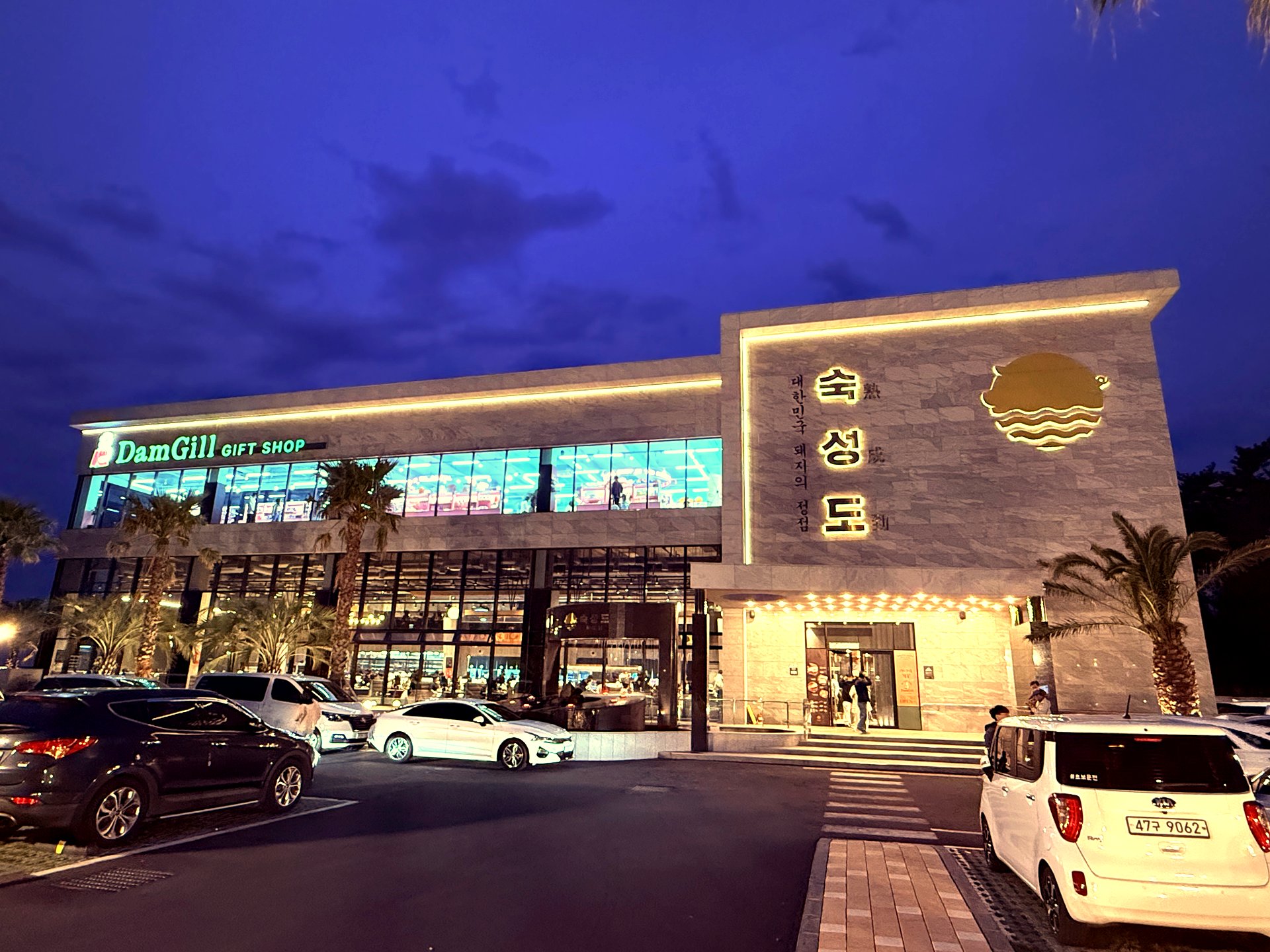
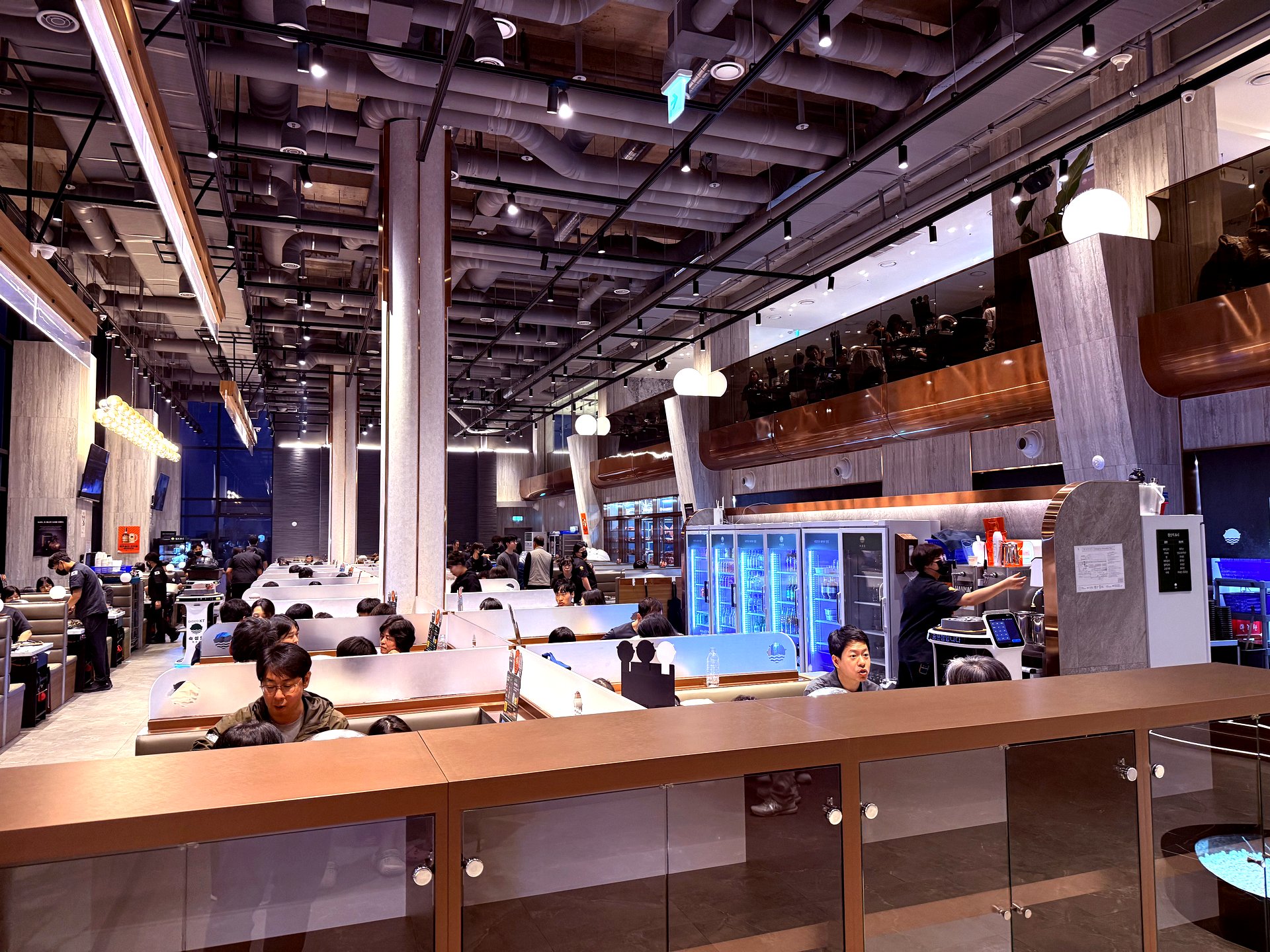
Sukseongdo Jungmun is not a small neighborhood pork joint. It’s a purpose-built two-story BBQ palace with a polished interior, an open prep area, a self-service banchan corner, and seating for serious volume. At night the building lights up like a small landmark.
The Self-Service Banchan Corner
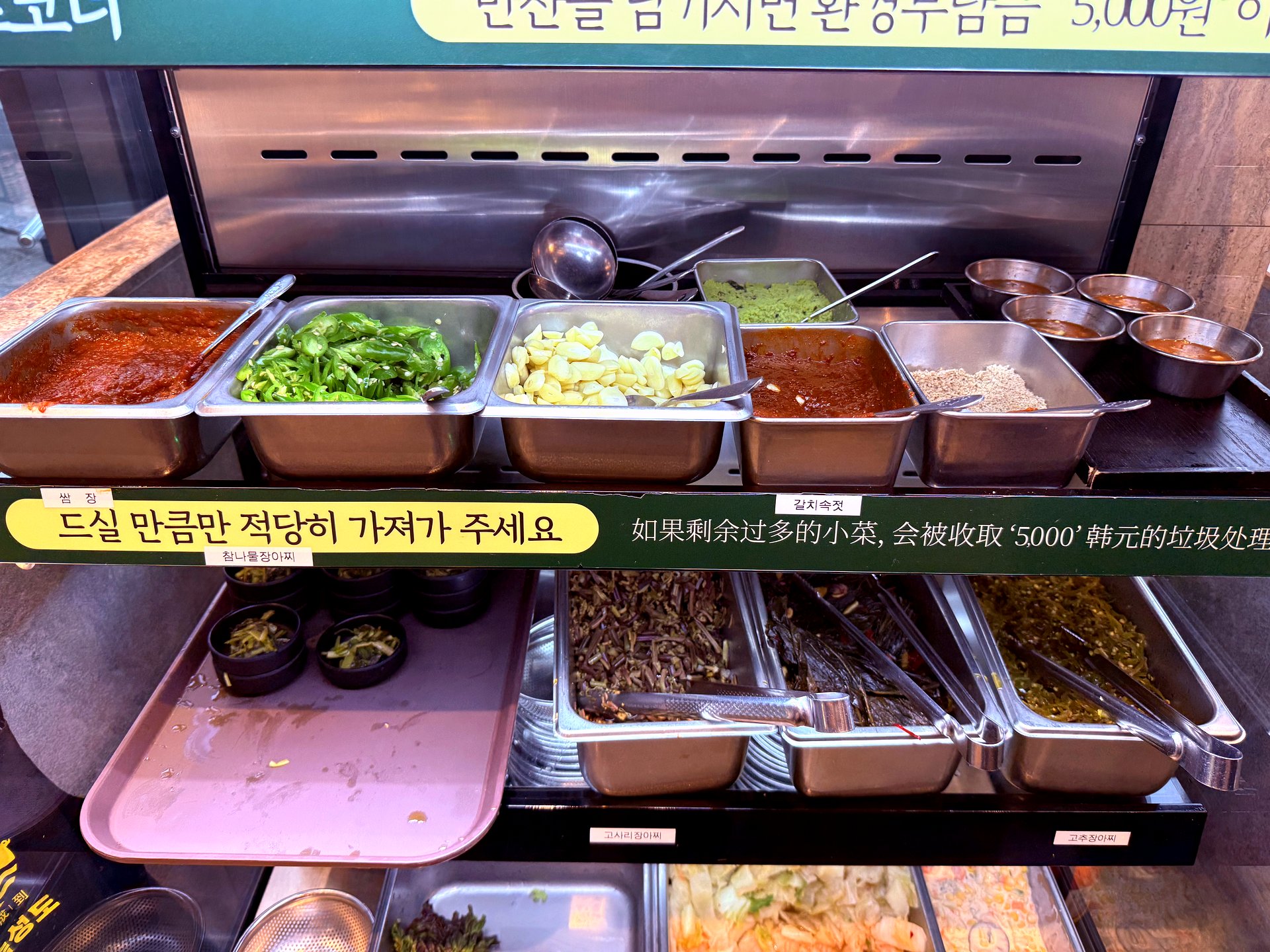
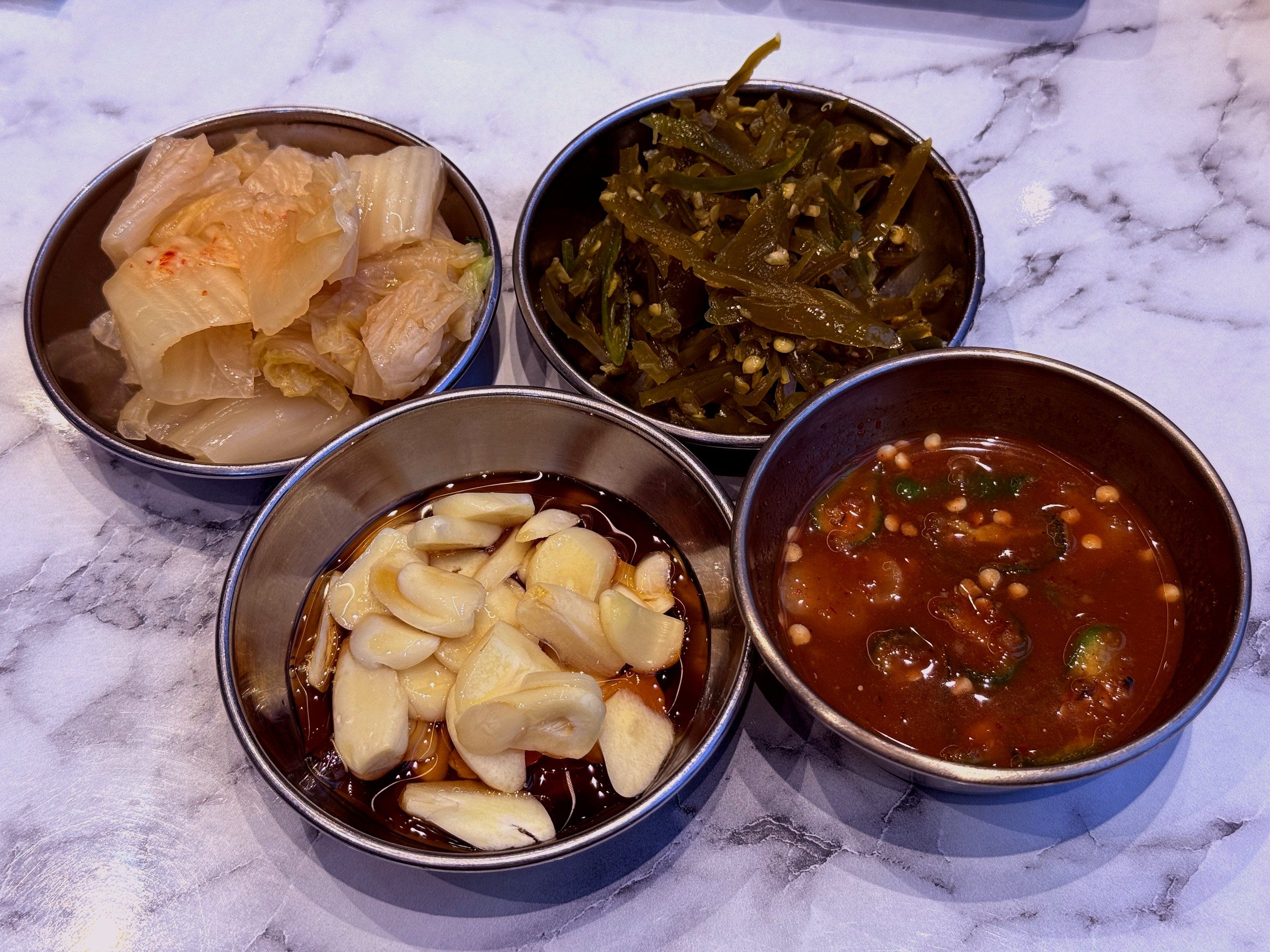
Walk in, get seated, and someone will point you toward the banchan station. It’s stocked with seasonal sides — fresh kimchi, pickled chili, garlic in soy, jeotgal-style relishes, namul of the day. Take what you want, refill as needed. The station also doubles as the place you grab the lettuce/perilla wraps for the meat. The signage warns that excessive leftovers will incur a small surcharge — Korean BBQ etiquette: take only what you’ll eat.
The Free Kimchi-Jjigae
Before any pork hits the grill, a complimentary kimchi-jjigae stew lands on the table. Don’t miss this — it is a real, well-cooked stew, not a perfunctory side. Slow-fermented kimchi, pork bits, tofu, and a long-simmered broth that punches above its complimentary status.
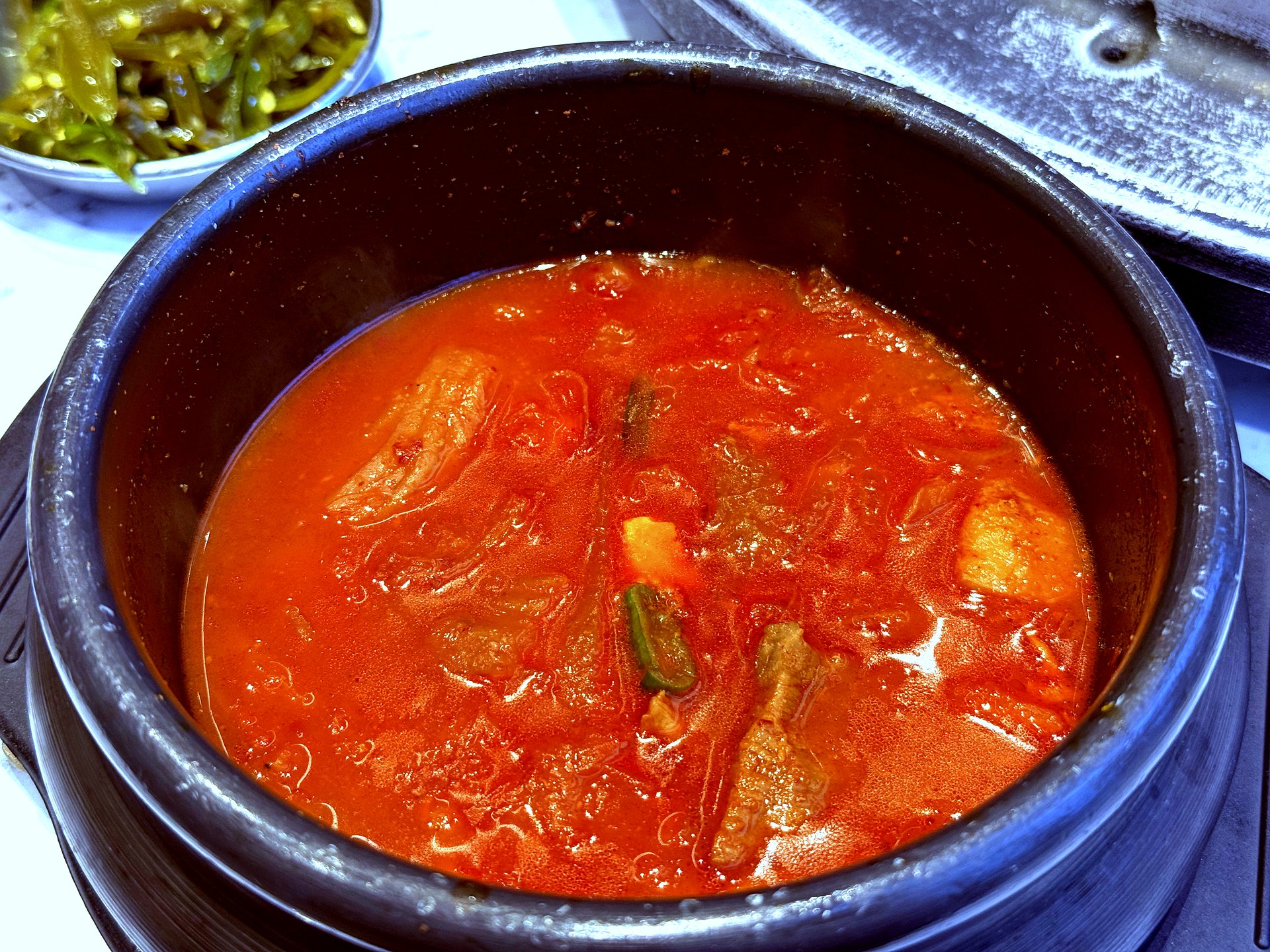
You’ll come back to it later, but the move is to spoon some over rice mid-meat to reset your palate.
The Grill — Charcoal, Hot, Precise
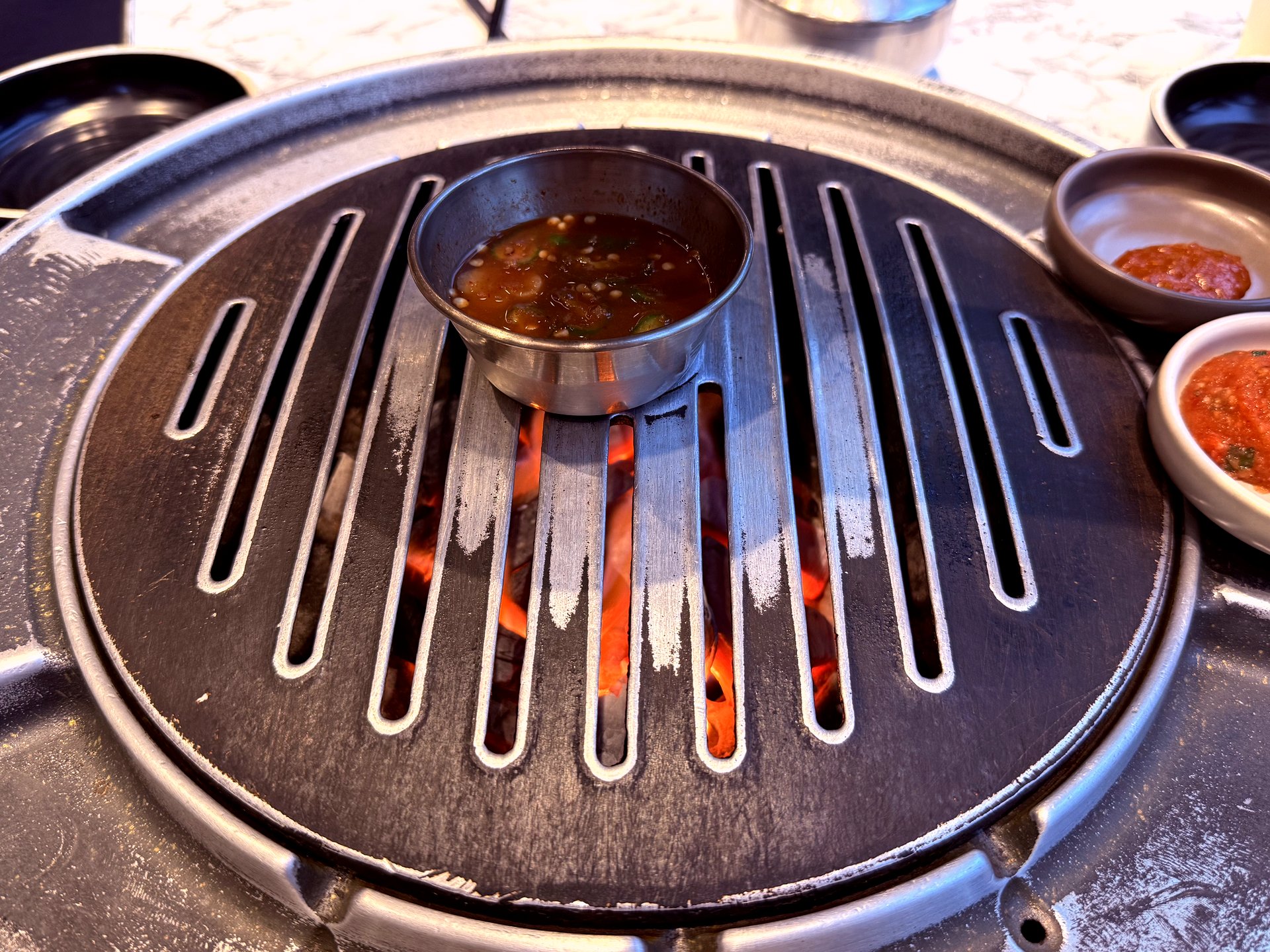
Real charcoal under a ribbed cast-iron grill plate. The center bowl holds 맬젓 (myeolchi-jeot, fermented anchovy sauce) — a Jeju-specific dipping condiment that goes on the grill so it warms slightly before each bite. This is one of the small details that separates a pork chain that takes itself seriously from one that doesn’t.
The Branded Mushroom — Sukseongdo’s Signature Flourish
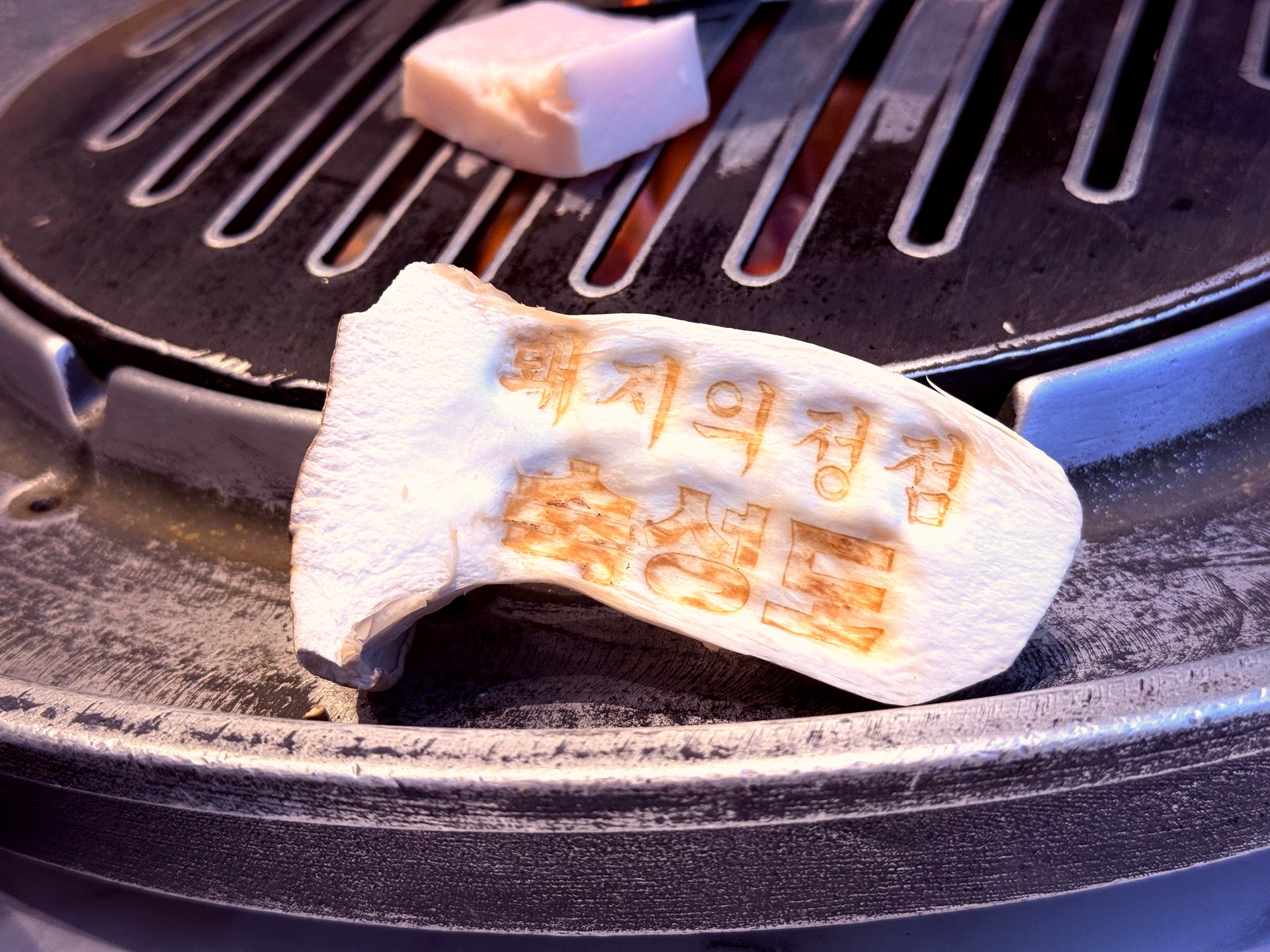
Before the meat goes on, the kitchen sets a thick slice of king oyster mushroom on the grill — but this one has Sukseongdo’s tagline burned into the cap with a hot iron: “돼지의 정점 — 숙성도” (Pork’s pinnacle — Sukseongdo). It’s a small theatrical detail that announces what kind of restaurant you’re in. The mushroom itself, slow-grilled in pork fat, becomes one of the better non-meat bites of the meal.
The Meat — 720-Hour Aged Samgyeopsal + 1% Ogyeopsal
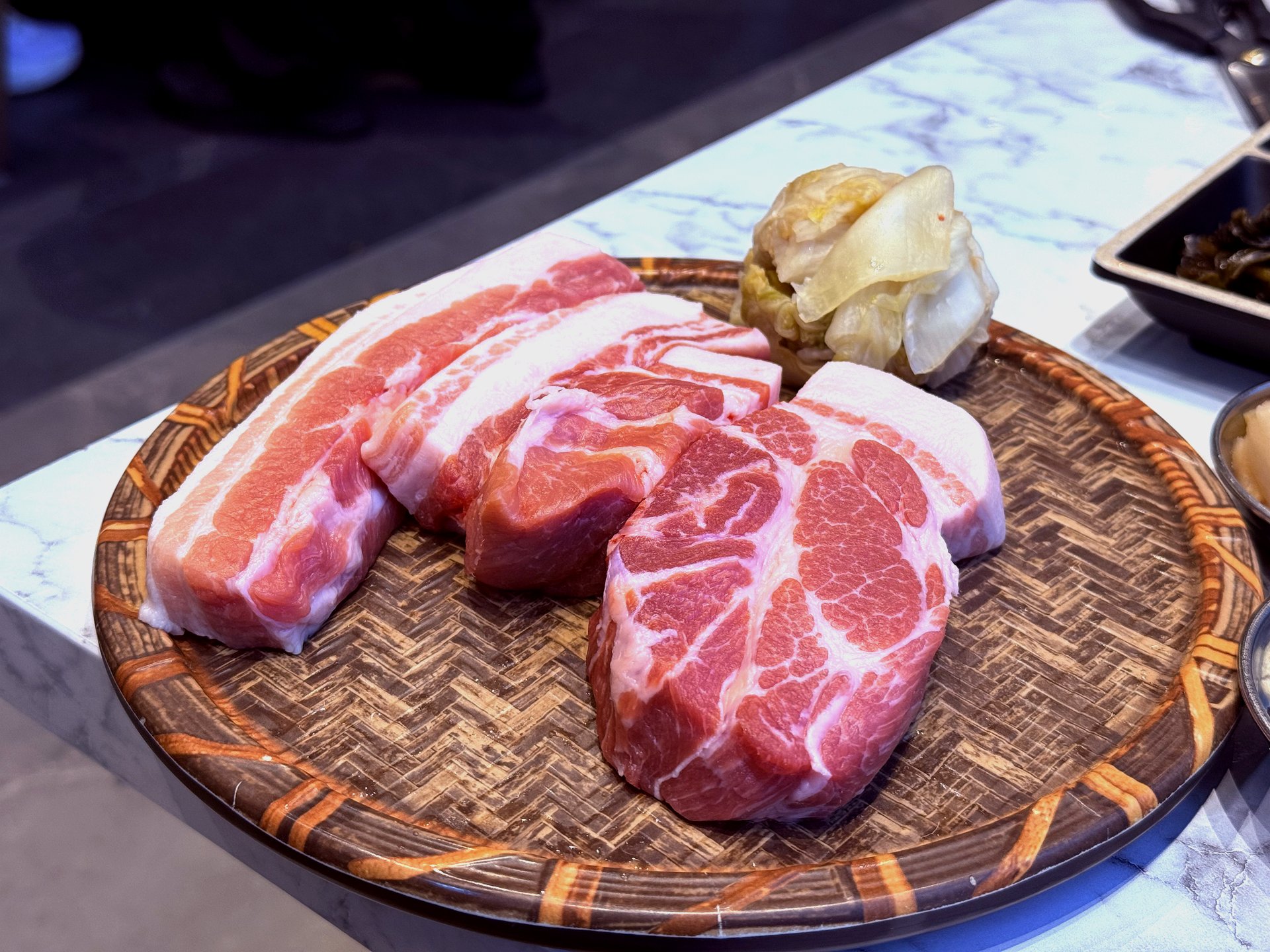
The meat comes out on a woven basket: 720 숙성 삼겹살 (aged pork belly, ₩23,000 ($16 USD)) on one side, 720 숙성 1% 목살 (aged collar — only 1% of the pig, ₩23,000 ($16 USD)) on the other. The colour gives it away: deep ruby instead of bubblegum pink, with the dry edges that mark properly aged meat.
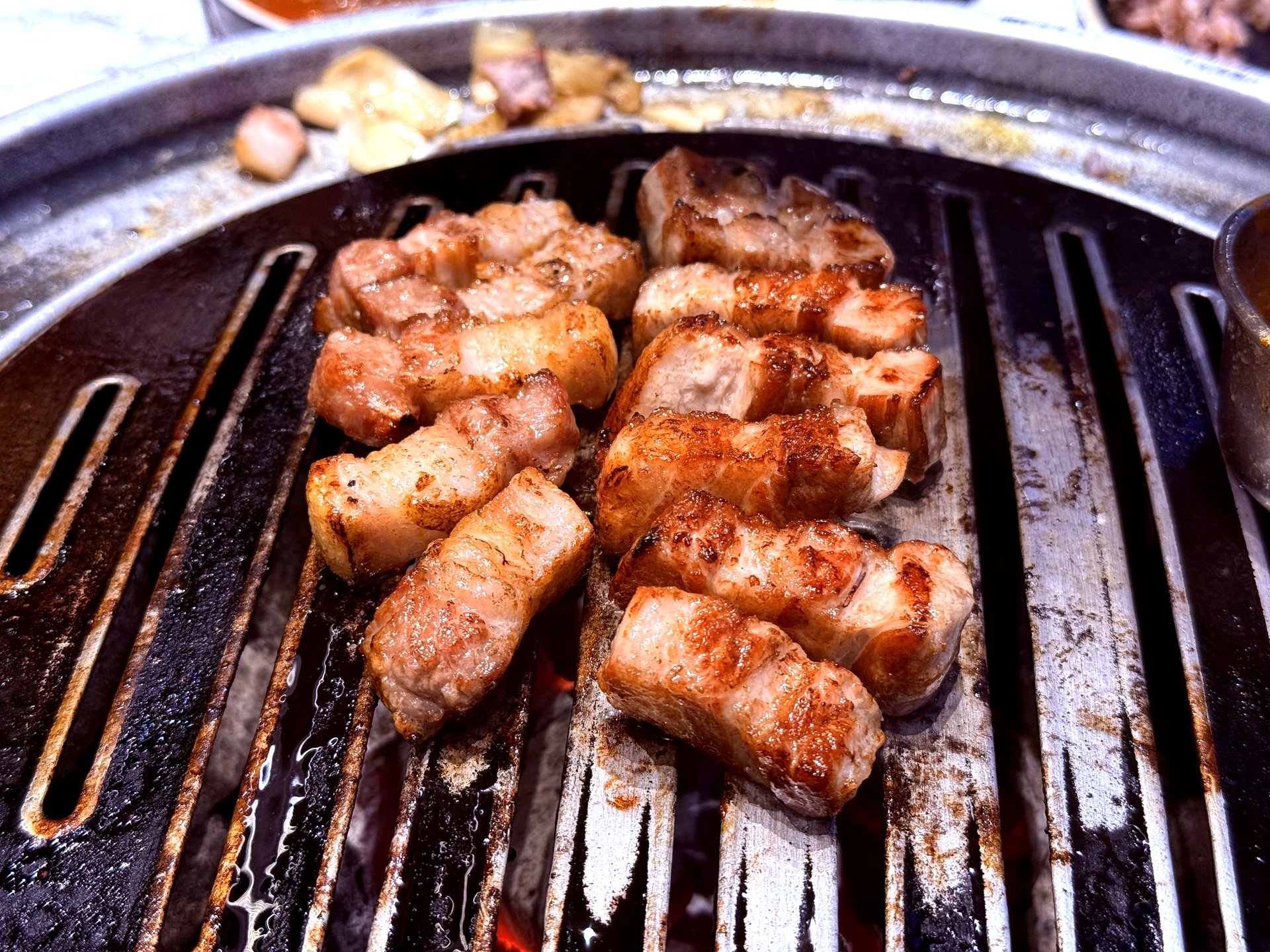
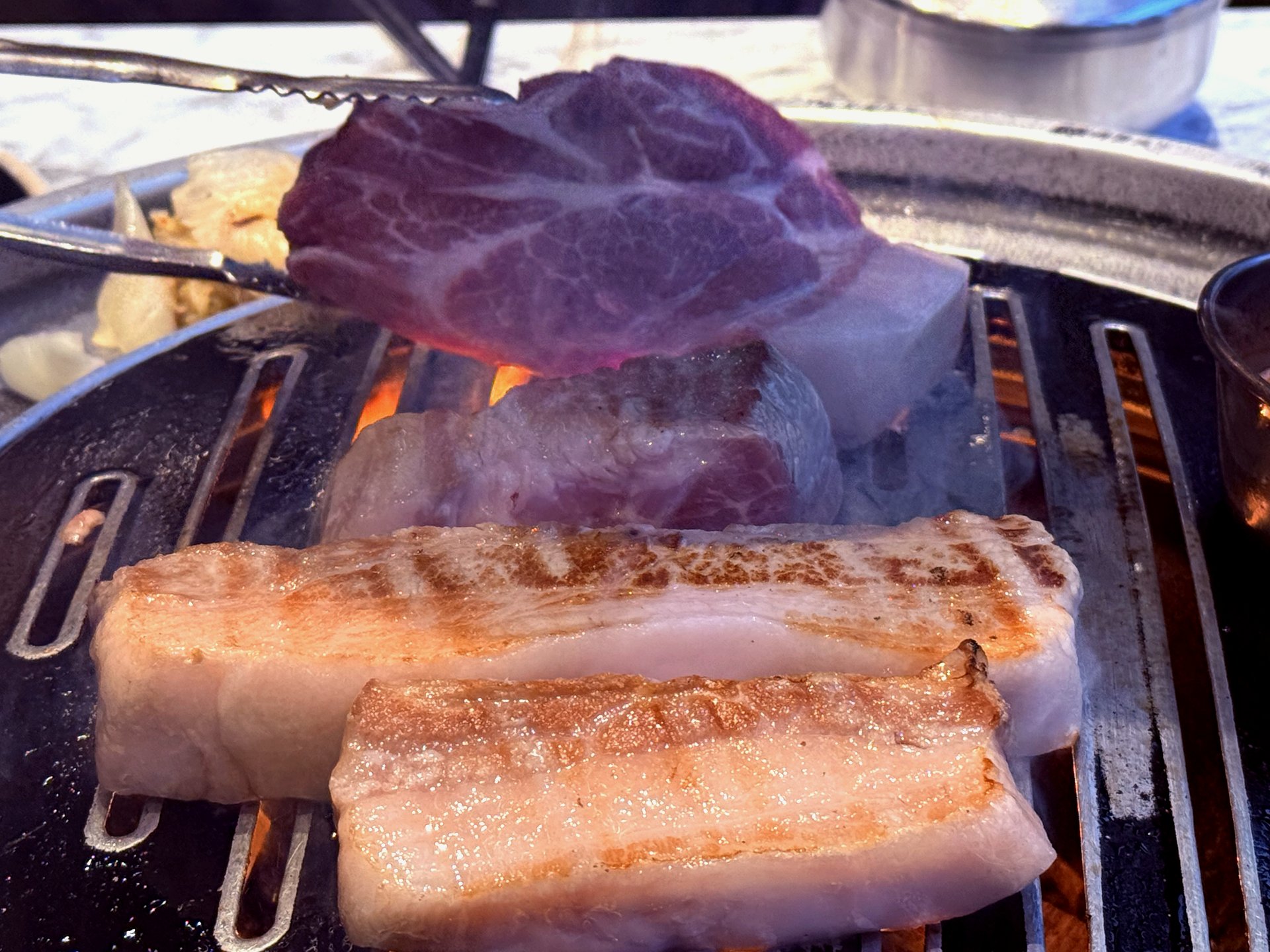
Then the cooking. Sukseongdo runs a table-side server-grills-it model — a trained staff member arrives, sets the heat, and grills your meat for you. Watching them work is part of the show. The pork sears in big slabs first to lock the juices in:
Then they get cut into bite-size pieces against the grain and seared again on all sides:
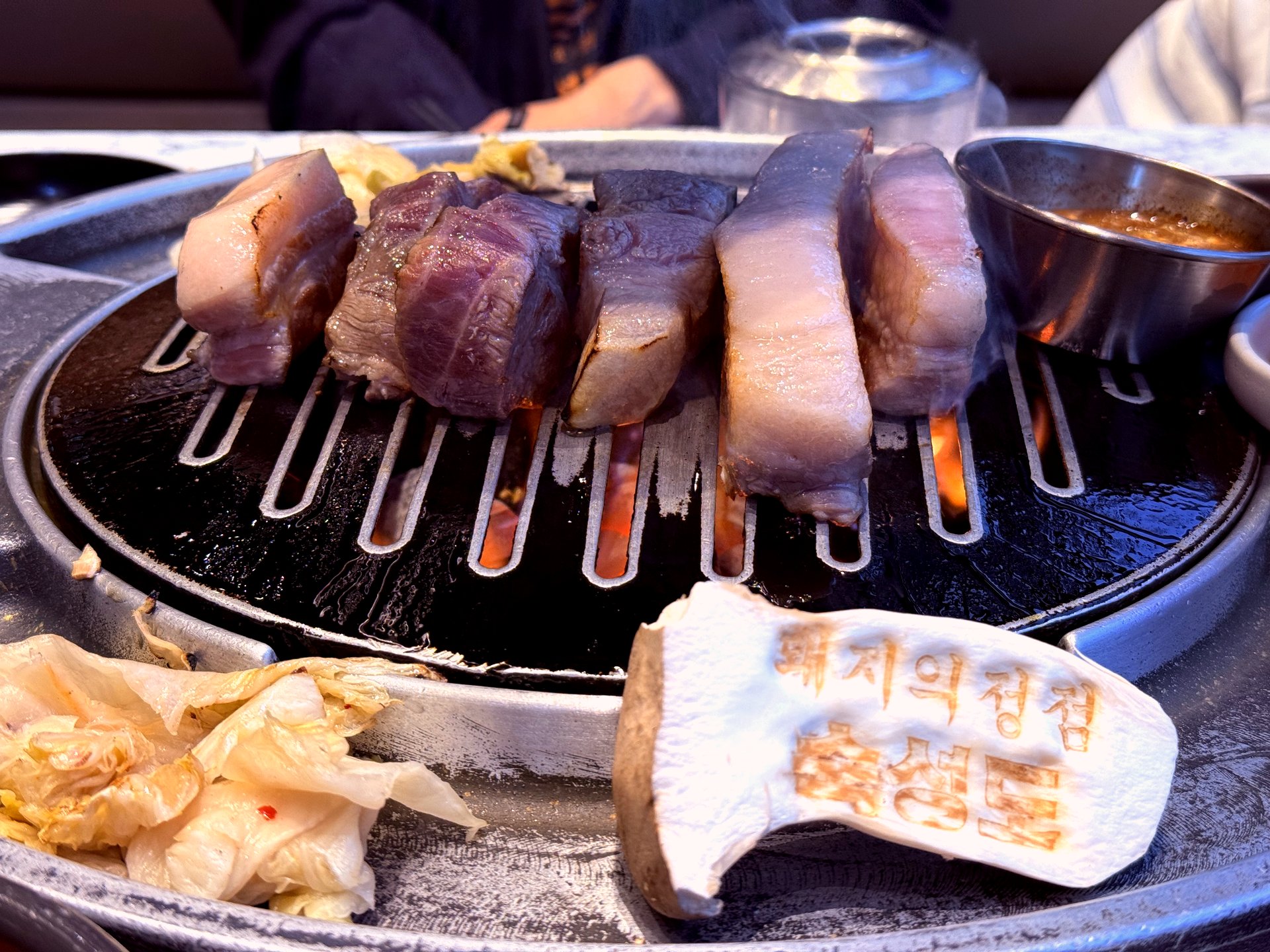
The texture is the headline. Aged pork has none of the chew of fresh pork — it cuts and pulls almost like a tenderloin. The fat behaves differently too, rendering more cleanly and tasting more nutty than greasy. The aging gives it a faint blue-cheese-adjacent funk that’s the whole point of the technique.
How to Eat It — The Local Combo
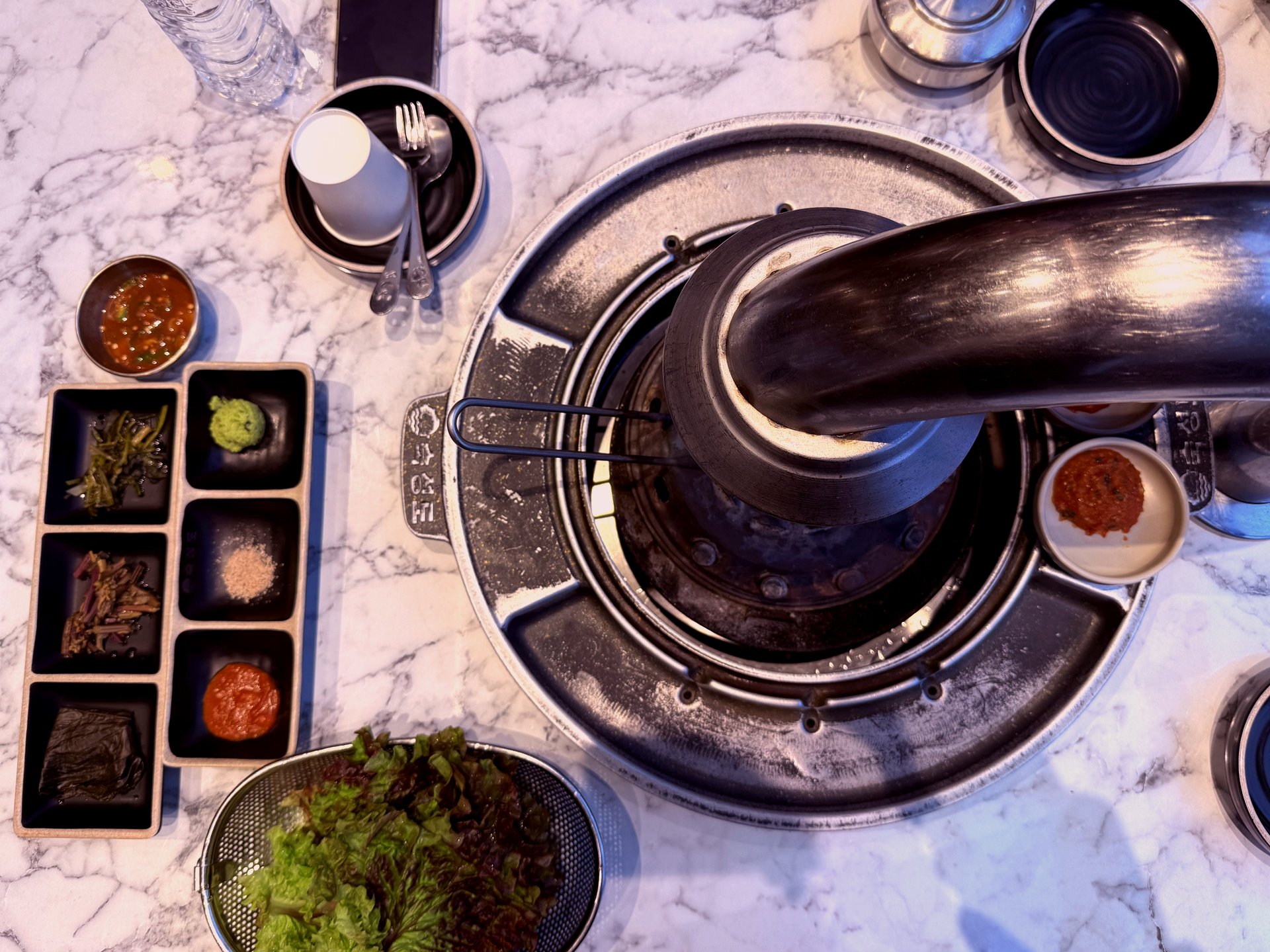
Locals build each bite with a stack of accents on the side: a thin slice of grilled pork, a dab of wasabi, a small leaf of 명이나물 (myeongi-namul, pickled wild garlic leaf), a sliver of 고추장아찌 (gochu-jangajji, pickled chili), and a quick dip into 맬젓 (myeolchi-jeot anchovy sauce) on the way to your mouth. The combination is — to use the user’s exact word — 극락 (geung-nak, Korean for “paradise” or “ultimate bliss”). The wasabi cuts the fat, the myeongi adds a vinegary punch, the gochu-jangajji brings heat, the anchovy paste seasons the whole thing, and the aged pork holds it all together.
The Dongchimi-Guksu — Order It Halfway Through
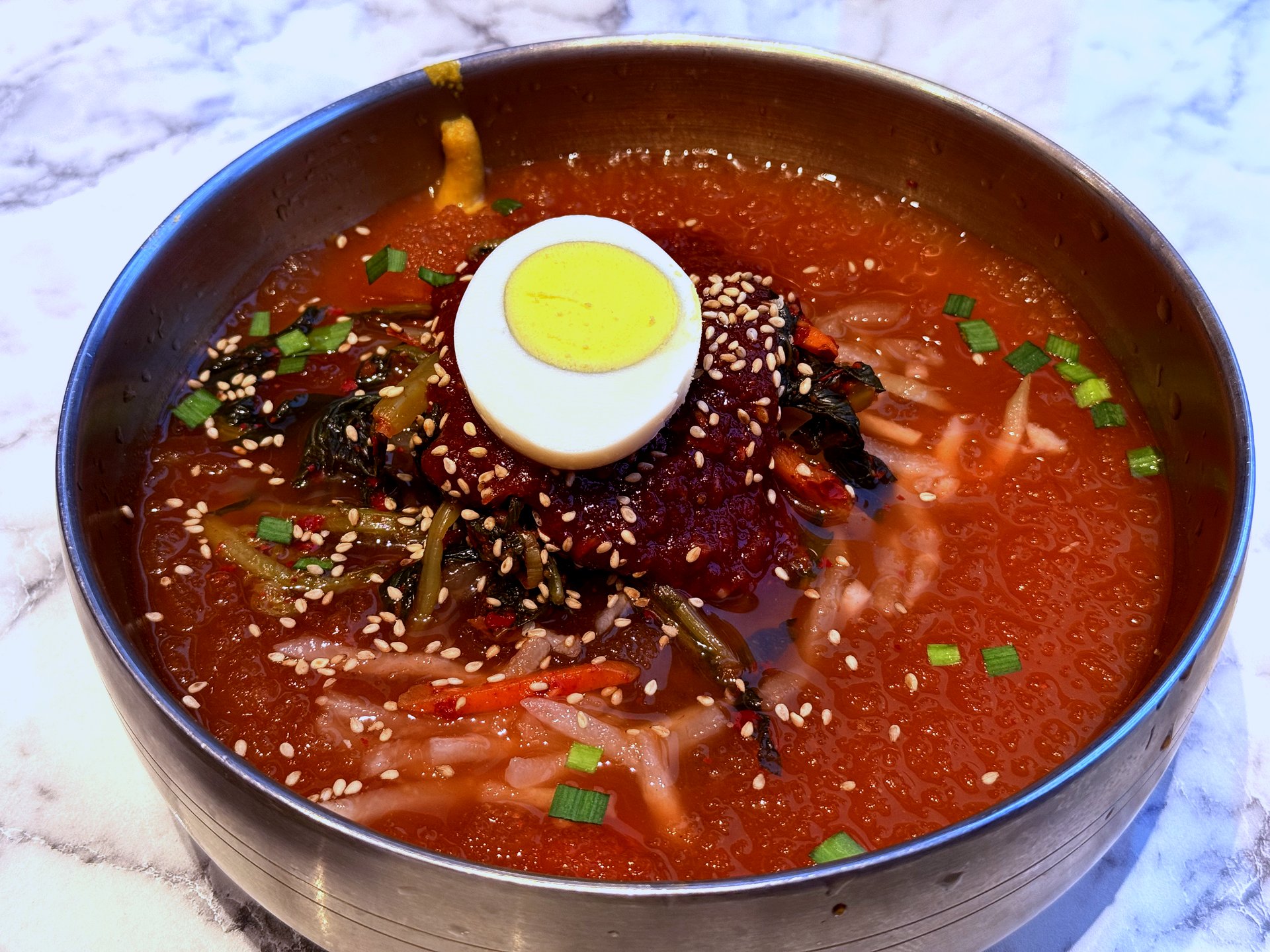
Don’t skip the 동치미국수 (dongchimi-guksu, ₩8,000 ($5.4 USD)) — chilled buckwheat noodles in a slightly-spicy fermented radish brine, topped with a half-boiled egg, sesame, and chopped scallion. After a few rounds of dense aged pork, this is the bowl that resets your palate. Korean BBQ veterans always order a cold noodle dish toward the back half of the meal for exactly this reason; Sukseongdo’s version uses dongchimi (radish water-kimchi) as the broth base, which gives it a mineral-y fermented depth that pairs particularly well with rich pork.
Practical Notes for Visitors
- Cards? Yes, all major.
- Wait? 1+ hour at peak. Use the Tableling app (테이블링) to reserve a day or two ahead.
- Foreign-friendly? Korean menu, but the table-side cooking model means you mostly point. Staff are used to international diners.
- Leftover policy: The banchan station has a posted note — take only what you’ll finish, or pay a small surcharge.
- Solo dining? Possible but not optimal. The cuts are sized for 2+.
- Pair with: a Jeju seafood lunch — see Dodu Haenyeo’s House, Eunhuine Haejangguk, Gojipdol Wureok, or finish at Cafe Jinjeongseong Jongjeom.
The Verdict
Sukseongdo earned its hype. The 720-hour aging is real and shows up in the eating: the meat is genuinely different from any fresh-pork BBQ in Korea, the technique behind the table-side cooking is well-trained, and the small theatrical details (the branded mushroom, the warmed jeotgal, the server-cut bites) make it feel like more than a chain operation. It’s not the cheapest Jeju pork dinner you’ll have — but at ₩23,000 ($16 USD) / 200g for properly aged 흑돼지, it’s still a fair deal for a category that does not exist this honestly almost anywhere else.
Reserve the day before. Show up hungry. Order the dongchimi-guksu at the halfway mark.
Go. Reserve on Tableling at least one day ahead, drive to Jungmun, and order the 720-hour aged samgyeopsal set + the 1% ogyeopsal cut. Don’t skip the dongchimi-guksu — order it halfway through, when the grill has reached peak fat-saturation. Don’t over-grill the aged meat — it is built for medium, not well-done. Trust the aging.
P.S. Second visit is when you also pre-order the kimchi-jjigae upgrade and stop pretending you came for the side dishes.
Been to Sukseongdo? Tell me what you ordered — drop a comment below.
More from Foodieseoul
- Best Jeju Seafood — Dodu Haenyeo
- Best Jeju Haejangguk — Eunhuine
- Best Jeju Hyangtosik — Gojipdol Wureok
- Best Donkkaseu in Jeju — Basak
- Coffee Near Jeju Airport — Cafe Jinjeongseong
| 🍽️ Food | 5.0 | |
| 💰 Value | 4.0 | |
| 🌏 Foreigner-friendly | 3.0 | |
| 📍 Access | 3.5 |
| Best for | Korean BBQ lovers, special-occasion Jeju dinners, anyone who wants pork that eats like steak |
| Skip if | You came for fast cheap eats, you cannot reserve in advance, you do not eat pork |
| Order this | 720-hour aged samgyeopsal set + 1% ogyeopsal + dongchimi-guksu finisher |
| Visited | 2026 – 1 visit |